
Review · JAPAN
From Asakusa: Old Tokyo, Temples, Gardens and Pop Culture
Tokyo rarely explains itself at first glance. This four-hour walk gives you a useful introduction, moving from incense and temple customs in Asakusa to Ueno’s market streets, Akihabara’s pop culture, and a quiet Edo-era garden. It is a lot of Tokyo in one morning or afternoon, but the route has a clear point: showing you how old and new Japan sit side by side.
I like the small maximum of eight people, which makes it easier to ask questions and adjust the pace. I also like the range of places, especially the sharp change from Senso-ji to Koishikawa Korakuen. The main drawback is that the schedule can feel rushed, particularly in crowded Asakusa, and one report says the local train costs were not covered despite the stated inclusions.
- Senso-ji first: Learn temple manners and the meaning behind Asakusa’s famous gates, shopping street, and statues.
- Four neighborhoods in one walk: The route links Asakusa, Ueno, Akihabara, and Koishikawa Korakuen.
- A true old-to-new contrast: Move from Buddhist tradition and Edo garden design to anime, electronics, and maid cafés.
- Small groups matter: With no more than eight people, guides such as Ken, Taka, Hiro, and Yapi can answer questions and adjust the walk.
- Train travel is part of the plan: Standard local train rides are listed as included, but confirm this before departure.
- Good for a first Tokyo day: You get cultural basics, neighborhood orientation, and practical help with the train system.
Why this route works for a first look at Tokyo
The best thing about this experience is its contrast. Many Tokyo tours focus only on temples or only on modern city life. This one links both. You start in Asakusa, where the city feels tied to older religious and market traditions, then pass through Ueno and Akihabara before ending among the ponds and paths of Koishikawa Korakuen.
That variety helps you place Tokyo on a mental map. You are not simply checking off four sights. You are seeing how a temple district, a food and market quarter, an electronics center, and a formal garden can all fit into one enormous city.
The group limit is important here. Eight people is still a group, but it is small enough for a guide to notice if you are lost in the crowd or want more time with a particular subject. The strongest guide comments praise people such as Taka, Ken, Hiro, Yapi, and Michelle for explaining culture clearly, answering questions, and changing the pace or focus when needed.
This is not a museum tour with long periods of sitting. You walk, use local transport, stand in crowded areas, and keep moving. You should have a moderate level of fitness and comfortable shoes. The four hours pass quickly because the route covers a great deal, but that also means you should not expect a leisurely, detailed visit at every stop.
Senso-ji and the customs of Asakusa
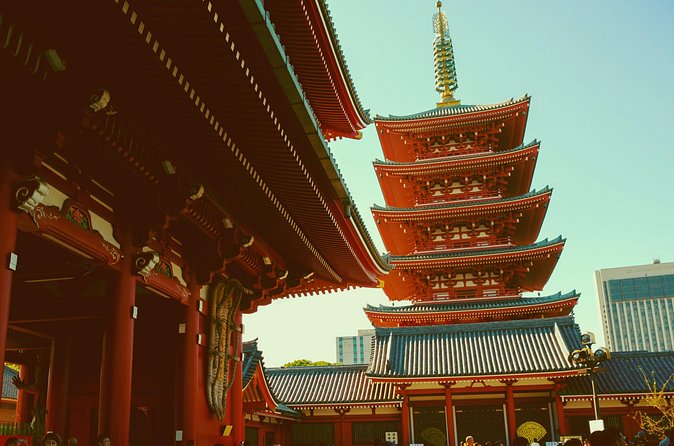
The tour begins at a meeting point in Asakusa, near 1-chome Asakusa. The precise address is listed as 1-1 Kamiyabiru, Tokyo 111-0032. Your first major subject is Senso-ji, Tokyo’s best-known Buddhist temple and one of the city’s most recognizable sights.
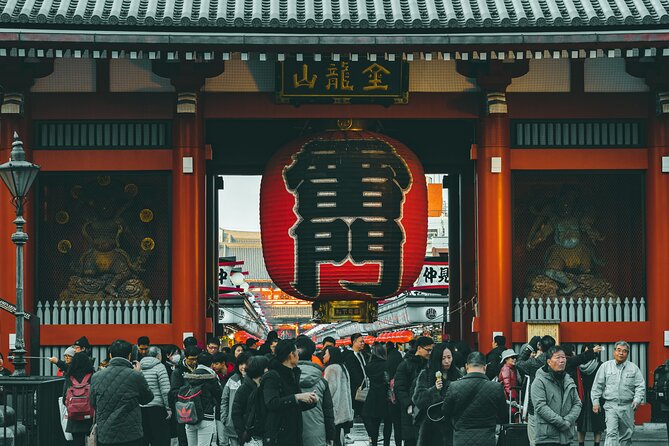
The useful part here is not just seeing the temple buildings. Your guide explains how to behave in a Japanese religious space, including basic etiquette and the meaning of features you might otherwise pass without understanding. That context can make a large difference. Without it, Kaminarimon, the Thunder Gate, Nakamise shopping street, incense, ropes, and statues are impressive but easy to treat as photo stops.
With a guide, you can learn why the gate matters, how the approach to the temple works, and what you are seeing on the grounds. One especially memorable detail mentioned during the tour is the giant rope footwear associated with warding off evil spirits. Small explanations like this turn a quick look into something you can recognize later at other temples.
The scheduled time in the Asakusa area is about 45 minutes, followed by roughly 15 minutes specifically at Senso-ji. That is enough for a useful orientation, but not enough for a slow study of every building or a long shopping session. Asakusa can be extremely crowded, especially around the temple approach. Stay close to your guide and make sure you can hear instructions before the group starts moving.
One person found the guide difficult to follow in the crowds and felt the group moved too quickly. That is worth taking seriously. A small group helps, but it does not remove the basic problem of navigating one of Tokyo’s busiest sightseeing areas. If you need frequent pauses or want extensive temple photography, tell the guide early.
More gardens worth a morning in Japan:
- Osaka: teamLab Botanical Garden Entry Ticket
★ 4.5 · 1,710 reviews - Imperial Palace East Garden and Edo Castle Walking Tour in Tokyo
★ 5.0 · 510 reviews - Kyoto Zen Meditation & Garden Tour at a Zen Temple with Lunch
★ 5.0 · 441 reviews
Ueno, where food and everyday Tokyo meet
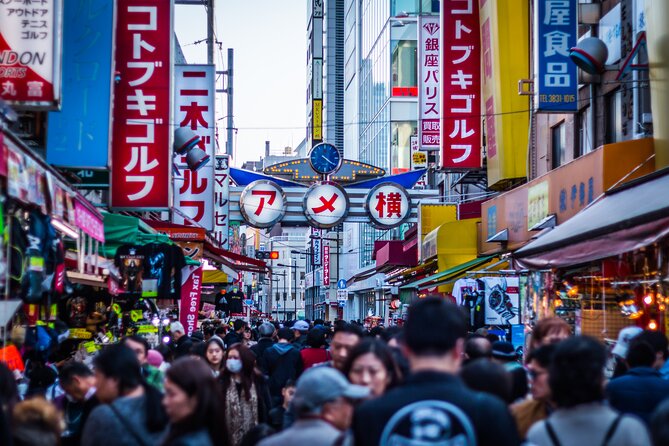
From Asakusa, the route heads toward Ueno. This area has long been associated with street sellers, shops, and food stalls. It gives you a different view of Tokyo from the polished image often presented around major temples and department stores.
The value of Ueno is its street-level feel. You are seeing a commercial district shaped by ordinary buying and selling, not just a formal attraction. The tour allows about 45 minutes here, which can include walking through market areas and learning how the district developed.
This is also a useful place to ask your guide for practical suggestions. Taka, for example, was praised for allowing time to shop during the Asakusa and Ueno portion. Other guides have helped with food ideas and plans for the rest of a Japan trip. The tour does not include food or drinks, so treat this part as a chance to ask where to eat later rather than assuming a meal is provided.
Ueno is another place where the pace matters. You may want to stop at a shop, take photographs, or examine foods and goods being sold. With only four hours for the complete route, you will need to choose between lingering and keeping the rest of the schedule intact.
Akihabara beyond the neon signs
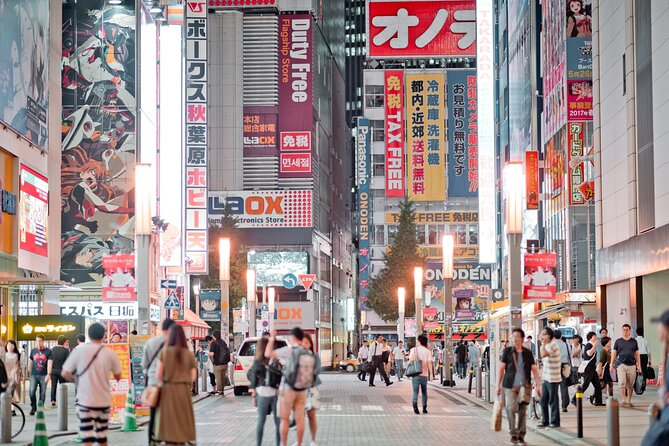
Akihabara brings the tour into modern Tokyo. It began as an electronics district and is now closely linked with anime, manga, games, specialty shops, and other forms of Japanese pop culture. The scheduled visit lasts about 45 minutes.
This section is most useful if you want a guide to explain what you are seeing. Akihabara can look like a wall of signs and storefronts when you first arrive. A guide can help place the district in context and point out parts of its popular culture that may not be obvious to an outsider.
One review describes the tour as covering maid cafés and other cultural details that the visitor would not have understood alone. That is a good reason to keep an open mind here. Akihabara is not simply an electronics street. It is also a place where specialized hobbies and carefully developed forms of entertainment are sold to a very broad audience.
Still, keep your expectations realistic. The pop culture portion may involve being shown several anime or specialty stores rather than entering a single major attraction. One disappointed participant felt this part amounted to being dropped off at various anime shops. If you want a full shopping excursion, this may feel too brief. If you want a quick introduction after visiting temples and markets, the contrast works well.
Koishikawa Korakuen, the quiet finish
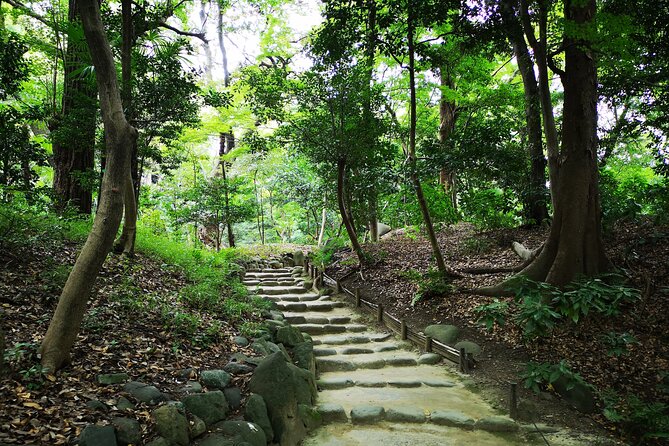
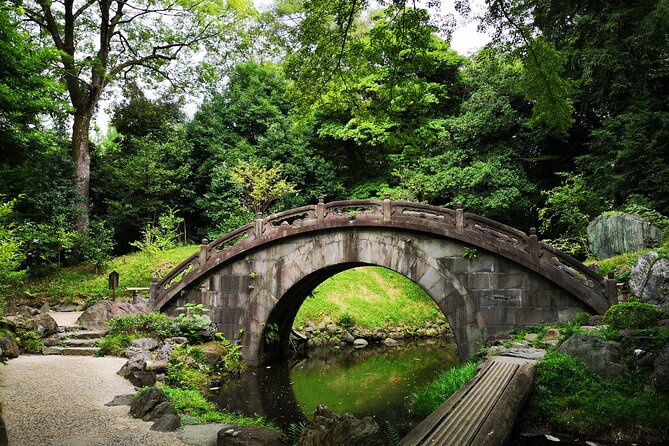
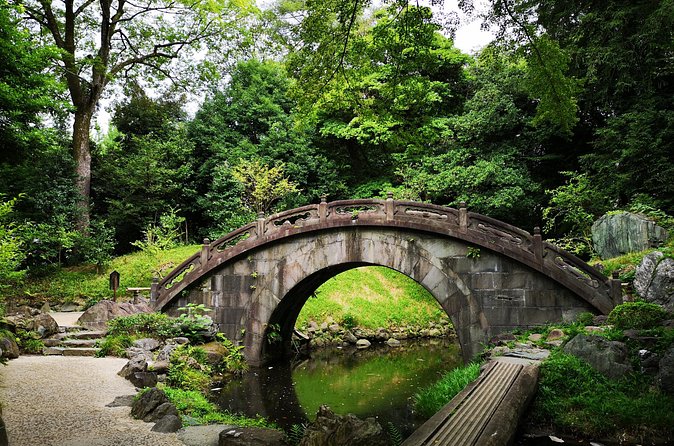
The final stop is Koishikawa Korakuen Garden, with about 45 minutes set aside for the visit. This is the part I find most appealing for the shape of the day. After temple crowds, market streets, and Akihabara signs, the garden gives you room to slow down.
Koishikawa Korakuen dates from the Edo period and was influenced by Confucian poetry. Its design uses water, paths, viewpoints, and carefully arranged scenery to create a series of changing scenes. You do not need to know every historical detail to appreciate the difference in mood, but the guide’s explanation helps you see the garden as a planned work of art rather than simply a patch of greenery.
The garden is also where the route’s old and new theme comes together. You have just seen a district shaped by electronics and pop culture. Now you are walking through a place linked to older ideas of beauty, poetry, and formal garden design. That change gives the tour a calm ending and keeps the experience from becoming a nonstop city march.
Admission to this garden is listed as included. The other listed stops have no separate admission charge. Food and drinks are not included.
Same season, a different set of beds:
- Mt. Fuji Day Trip from Tokyo with English Speaking Driver Guide
★ 5.0 · 443 reviews - Kyoto Arashiyama Bamboo forest & Garden Half-Day Walking Tour
★ 5.0 · 413 reviews - Tokyo: Imperial Palace East Gardens Walking Tour
★ 4.8 · 353 reviews - Mt. Fuji, Cherry Blossom & Shiba Sakura Pvt. Day Tour
★ 5.0 · 326 reviews
What the four-hour pace feels like
Four hours is a smart length for a first orientation, but it is not a relaxed full-day tour. You will cover several neighborhoods and use local transport, so there is little room for long detours unless the group is small or the guide adjusts the plan.
The strongest experiences appear to come when the guide treats the schedule as a framework rather than a rigid script. Ken, Taka, Yeman, Katsu, and others are described as changing parts of the route to suit interests, answering questions, or spending more time in places that appeal to the group. In some cases, a booking has effectively become a private tour because no other participants arrived.
That possibility is a pleasant bonus, not something to count on. The advertised maximum is eight people. A small group gives you a better chance to speak with the guide, but the size can vary.
The walk is also a good way to learn Tokyo’s rail system. Several guides have helped people understand how to use the trains, which can be valuable early in a Japan trip. The tour includes standard local train rides according to the stated details. However, one participant said they had to pay their own fares. Since that conflicts with the listed inclusion, confirm the arrangement with Pinpoint Traveler before setting out and carry a transit card or some yen as a backup.
Guides and the value of personal attention
The guide is the biggest variable in an experience like this. The tour has been led by Taka, Hiro, Michelle, Johann, Yapi, Matt, Hiroshi, Yeman, Shizuko, Toru, Ken, Andrew, and Katsu. The most praised qualities are clear English, patience, humor, local familiarity, and a willingness to tailor the route.
Ken receives especially strong praise for explaining history and culture, helping families understand the train system, and answering questions. Taka is described as funny, well prepared, and flexible. Yapi is praised for patient, detailed explanations. Hiro and Hiroshi are noted for taking people to places they might not locate alone. Shizuko is singled out for keeping a good pace and helping with photographs.
That range tells you what to look for from the guide: not a memorized speech, but someone who can connect each neighborhood to your interests. If you care about religion, ask for more explanation at Senso-ji. If you like shopping, say so in Ueno or Akihabara. If you are new to Tokyo trains, ask for help before the tour ends.
The one poor experience points to two practical needs. First, ask how the guide will identify the group in a crowd. Second, speak up if you cannot hear. A small group should make this possible, but you still need to be direct.
Is $70.49 a fair price?
At $70.49 per person, the price is reasonable if you want orientation, transport help, and cultural explanation in one compact outing. The value is not in admission tickets, since most stops are free. It comes from the guide, the route planning, the local train connections, and the time saved figuring out how to link these districts yourself.
The price looks better if you are in Tokyo for only a short stay or if this is your first day in the city. You can learn temple manners, get a feel for market neighborhoods, see Akihabara without spending hours guessing where to go, and finish in a garden. You also receive a starting point for the rest of your visit.
The value is weaker if you already know Tokyo well or mainly want unhurried shopping. You may prefer to spend several hours in one district rather than move through four. You also pay for a group experience, so the day will not be fully private unless the booking happens to have no other participants.
Group discounts are available, and mobile tickets make the booking simple. Free cancellation is available up to 24 hours before the start time. Poor weather can lead to a new date or a full refund, while late cancellations are not refunded.
Who should book this Tokyo walk?
I would choose this tour for a first visit, a short stay, or a traveler staying in modern western Tokyo who wants to see the older eastern side. It works particularly well for families and couples who want explanations without committing to a full-day program.
It also suits people who feel unsure about temple etiquette or Tokyo’s train system. The guides explain customs and can help you get your bearings for later independent exploring.
I would be more cautious if you have limited mobility, dislike walking in crowds, or want long stretches for shopping. The route requires moderate fitness, and Asakusa can be hard to navigate. You should also confirm the train fare policy before booking.
Should you book it?
Book this tour if you want a well-paced introduction to several sides of Tokyo and value a guide who can answer questions in the moment. The mix of Senso-ji, Ueno, Akihabara, and Koishikawa Korakuen is unusually broad for four hours, and the small group makes the route more personal than a large coach outing.
Skip it if your priority is a slow temple visit, a serious shopping session, or a private custom itinerary. For most first-time visitors, though, the old-to-new route offers a useful first picture of Tokyo, especially when you tell your guide what interests you and confirm the local transport details ahead of time.
FAQ
How long is the Tokyo walking tour?
The tour lasts approximately four hours.
What places does the tour visit?
The route includes Asakusa, Senso-ji Temple, Ueno, Akihabara, and Koishikawa Korakuen Garden.
How many people can join the tour?
The tour has a maximum of eight participants.
Are train rides and admission fees included?
The tour information lists all standard costs while on the tour, including admissions and local train rides. One participant reported paying for trains, so confirm the fare arrangement before departure.
Is food included?
No. Food and drinks are not included.
Where does the tour end?
The tour ends at Akihabara Station, at 1 Chome Sotokanda, Chiyoda City, Tokyo 101-0028.
What is the cancellation policy?
You can cancel at least 24 hours before the start time for a full refund. Cancellations or changes made less than 24 hours before the start time are not refunded. If poor weather cancels the tour, you are offered another date or a full refund.
Newly planted garden visits around Japan
- Kyoto-Nara Adventures Private Tour With Hotel Pick Up★ 4.0 · 5 reviews
- Stunning Private Tea Ceremony: Camellia Garden Teahouse★ 5.0 · 28 reviews
- Guided Kyoto City Cherry Blossom One Day Private Tour★ 5.0 · 16 reviews
- Kyoto Hidden Treasures: Special Temple & Garden Access Tour★ 4.5 · 25 reviews
- Kyoto: Kinkaku-ji Temple & Serene Garden Guided Tour with Tickets★ 5.0 · 9 reviews
- The Art of Mindful Living: Tea Ceremony in Kyoto★ 5.0 · 16 reviews
- Kyoto ITALIAN GUIDE Golden Pagoda Bamboo Forest Dry Garden★ 4.0 · 2 reviews
- Kyoto Japanese Garden Lover’s Private Tour with Government-Licensed Guide★ 4.5 · 10 reviews
Japan Garden Tours, bed by bed.

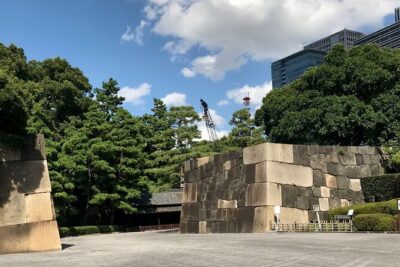
Imperial Palace East Garden and Edo Castle Walking Tour in Tokyo
Read our review →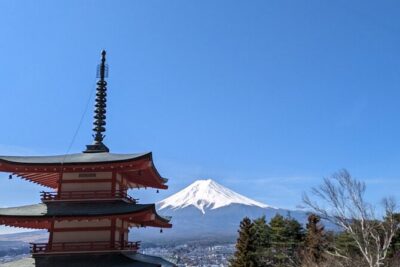
Mt. Fuji Day Trip from Tokyo with English Speaking Driver Guide
Read our review →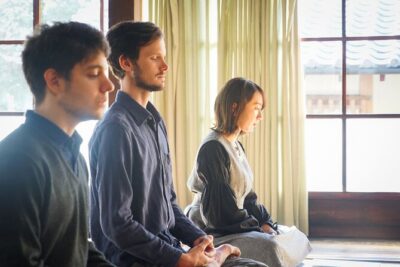
Kyoto Zen Meditation & Garden Tour at a Zen Temple with Lunch
Read our review →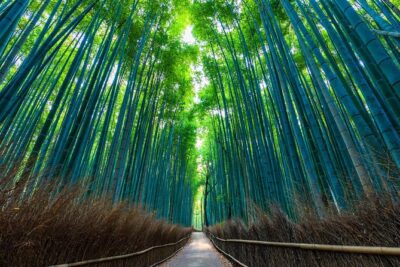
Kyoto Arashiyama Bamboo forest & Garden Half-Day Walking Tour
Read our review →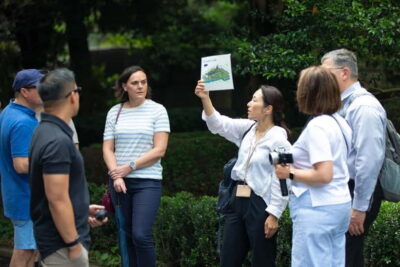
Tokyo: Imperial Palace East Gardens Walking Tour
Read our review →
Kyoto Kiyomizu Tea Ceremony with Scenic Garden Views
Read our review →Lists this garden visit belongs to