
Review · KANAZAWA
Kanazawa: Half-Day Private Tour – Garden, Castle, Geisha
Kanazawa packs an impressive slice of old Japan into four hours: a castle park, one of the country’s celebrated gardens, a striking shrine gate, and a teahouse district where gold leaf and traditional crafts still shape the visit. I like the way this tour connects grand sights with small details, from Oyama Shrine’s unusual Japanese-Western gate to gold leaf art and local sake in Higashi Chaya.
I also like the private format. Guides such as Megumi, Lee Stephen, Sho, and Gucci have adjusted pacing, changed plans in bad weather, and offered food recommendations when useful. The catch is that four hours moves quickly, and this is a walking tour with stairs and uneven ground, so it is not suited to wheelchair users or people with mobility impairments.
Key points at a glance
- Oyama Shrine begins the story: Meet beneath its unusual Shinmon Gate, a landmark mixing Japanese and Western design.
- Kanazawa Castle comes with garden time: See Gyokusen’inmaru Garden, Hishi Yagura, Gojikken Nagaya, Hashizume Gate, and San-no-maru Square.
- Kenrokuen is the visual centerpiece: Allow an hour for ponds, pines, viewpoints, and Sazaeyama Hill.
- Higashi Chaya adds craft and atmosphere: Browse gold leaf work, Kutani ware, and local sake in a historic teahouse quarter.
- Private guiding adds flexibility: Your guide can adjust the pace, respond to rain, and suggest places for lunch, dinner, or snacks.
- The price buys focus, not just admission: At $150 per person, the value is strongest for visitors who want context and a custom pace rather than a simple sightseeing walk.
Why this four-hour route works in Kanazawa
Kanazawa is easy to underestimate. The main sights sit close enough to connect, yet each has a different mood. Oyama Shrine feels ceremonial and slightly unexpected. Kanazawa Castle brings military architecture and open park space. Kenrokuen supplies classic garden design. Higashi Chaya finishes with wooden teahouses, crafts, and shopping.
I like this route because it avoids treating the city as one long museum stop. You move between religion, power, garden design, and entertainment culture. That gives you a clearer sense of how Kanazawa developed and why its traditional arts remain such a large part of the city’s identity.
The tour begins at the Shinmon Gate of Oyama Shrine. Look for the guide holding a yellow DeepExperience sign. Since this is a private group, you do not have to match the pace of a large crowd. That matters in gardens, where pausing for a photograph or asking about a particular tree can otherwise feel rushed.
Half-day garden visits around Japan:
- Kyoto Arashiyama Bamboo forest & Garden Half-Day Walking Tour
★ 5.0 · 413 reviews - From Paris: Giverny, Monet’s Home & Gardens Half-Day Trip
★ 4.5 · 2,887 reviews - From Avignon: Half-Day Lavender Tour of Luberon
★ 4.8 · 232 reviews
Oyama Shrine and the Shinmon Gate
Oyama Shrine is a smart starting point because its entrance immediately raises a question: why does a Japanese shrine have a gate with such an unusual mix of styles? Your guide uses the gate and grounds to explain the shrine’s importance and the city’s past.
The Shinmon Gate is the visual hook. Its design combines Japanese and Western elements, making it unlike the standard shrine entrance you may see elsewhere in Japan. The grounds offer a quieter opening than a busy shopping street, with gardens that give you time to settle into the tour.
The scheduled stop is about 15 minutes, so expect an introduction rather than a long architectural study. That short visit works well if you want to reach the castle and garden areas without spending the whole morning at the first sight.
Kanazawa Castle Park and Gyokusen’inmaru Garden
From Oyama Shrine, the route moves into Kanazawa Castle Park. Here the focus shifts from religious symbolism to the scale and precision of castle architecture.
Gyokusen’inmaru Garden is one of the most attractive parts of this stop. Its design uses water, planting, paths, and changes in level to create a calm setting within the castle grounds. The seasonal appearance will vary, but the basic pleasure remains the same: this is a place to slow down and look at how the garden has been arranged rather than simply pass through it.
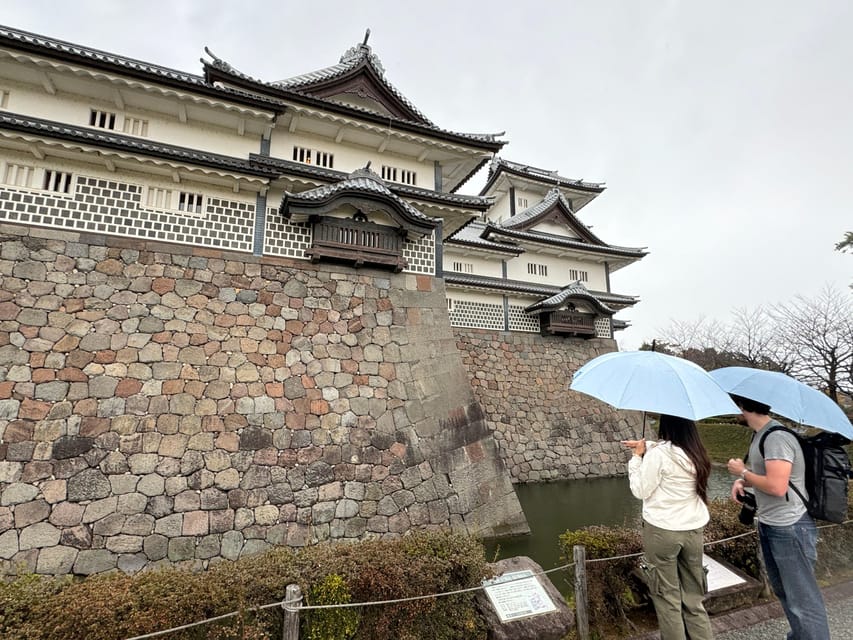
The castle section lasts about 45 minutes. Your guide points out Hishi Yagura, Gojikken Nagaya, and Hashizume Gate, along with San-no-maru Square. These names can blur together on a self-guided walk, so an English explanation helps you understand which structures served defensive or connecting roles.
I especially like the contrast between the broad square and the more carefully framed garden views. The castle park is not just a collection of restored buildings. It gives you a sense of scale, movement, and the relationship between defensive architecture and formal open space.
You should still set expectations correctly. This is not a full castle museum visit with hours of interior exhibits. The tour gives you a guided look at the park, major structures, and garden. If castle interiors are your main interest, you may want extra time on your own after the tour.
Kenrokuen’s ponds, pines, and high viewpoints
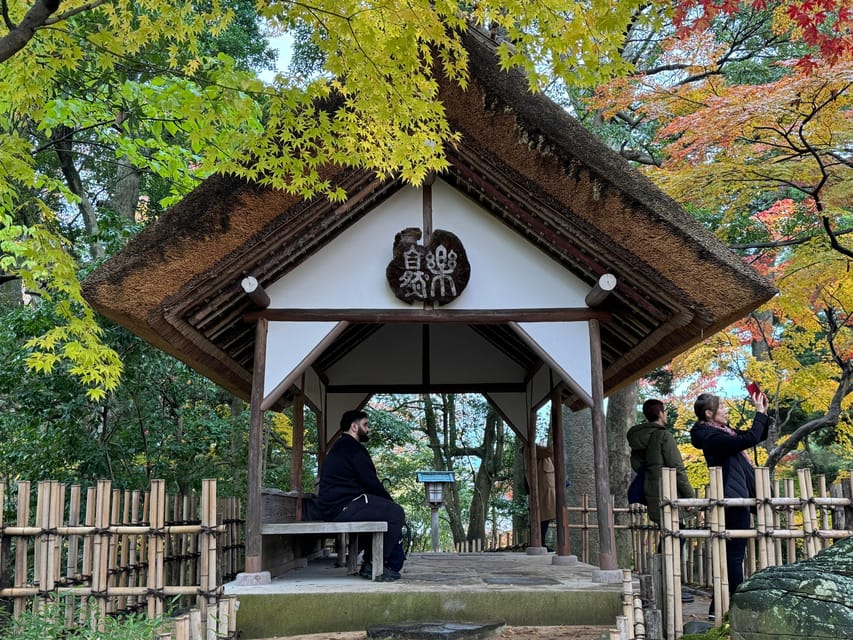
Kenrokuen receives about an hour, making it the longest sightseeing stop. That is sensible. The garden is large enough that a quick walk would reduce it to a list of names and photographs.
The route includes the Viewing Platform, Kasumigaike Pond, Karasaki Pine, and Sazaeyama Hill. Each offers a different way to read the garden. The viewing area gives you a broader outlook. Kasumigaike Pond brings reflections and carefully placed features. Karasaki Pine draws attention to the care given to individual trees. Sazaeyama Hill adds a change in height and a more layered view across the grounds.
The guide’s role matters here. Japanese gardens can look simple until someone explains why a path bends, why a tree is framed from one particular angle, or how water changes the feeling of a scene. You will get more from the garden if you ask about design choices instead of only hunting for the most famous photograph.
Kenrokuen can also be the busiest part of the route. The one-hour window is enough for a focused visit, but not for every corner. If you already know the garden and want time for a slow solo walk, tell your guide early. A private group gives you room to discuss priorities, though the overall four-hour schedule still has limits.
Wear shoes you can walk in comfortably. The itinerary includes several walking stops, and a garden visit is more pleasant when you are not thinking about sore feet. Bring water, a hat, sunscreen, and a camera. The advice is practical rather than decorative: much of the experience happens outdoors.
More gardens worth a morning in Japan:
- Osaka: teamLab Botanical Garden Entry Ticket
★ 4.5 · 1,710 reviews - Imperial Palace East Garden and Edo Castle Walking Tour in Tokyo
★ 5.0 · 510 reviews - Kyoto Zen Meditation & Garden Tour at a Zen Temple with Lunch
★ 5.0 · 441 reviews - Tokyo: Imperial Palace East Gardens Walking Tour
★ 4.8 · 353 reviews
The ten-minute transfer to Higashi Chaya
A bus or coach transfer of about 10 minutes connects Kenrokuen with Higashi Chaya District. It is a small but useful break between two walking-heavy sections.
The transfer also keeps the tour focused. Instead of spending the next part of the morning figuring out city transport, you move directly to the teahouse quarter with your guide. The listing does not promise a private vehicle for the whole experience, so think of this as a short arranged connection, not a chauffeured tour.
Higashi Chaya and Kanazawa’s traditional crafts
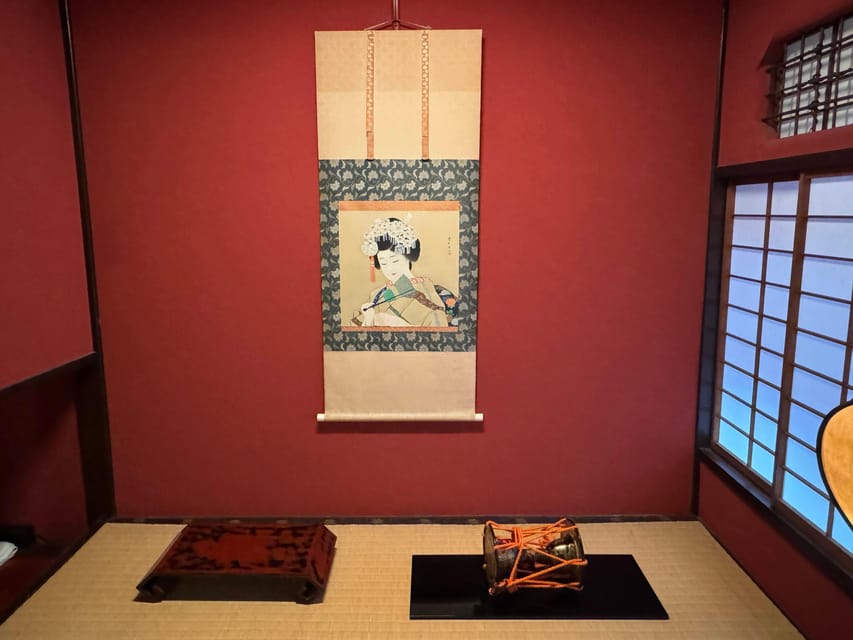
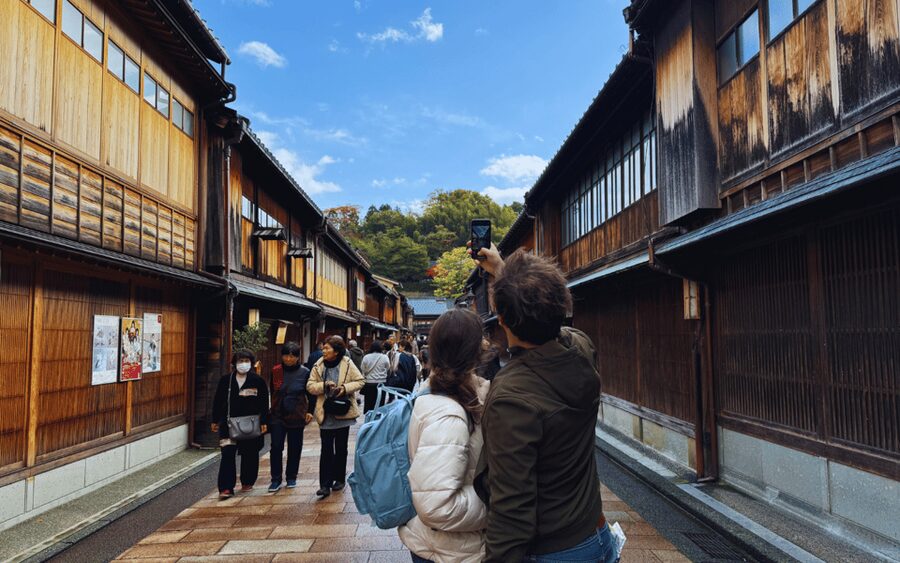
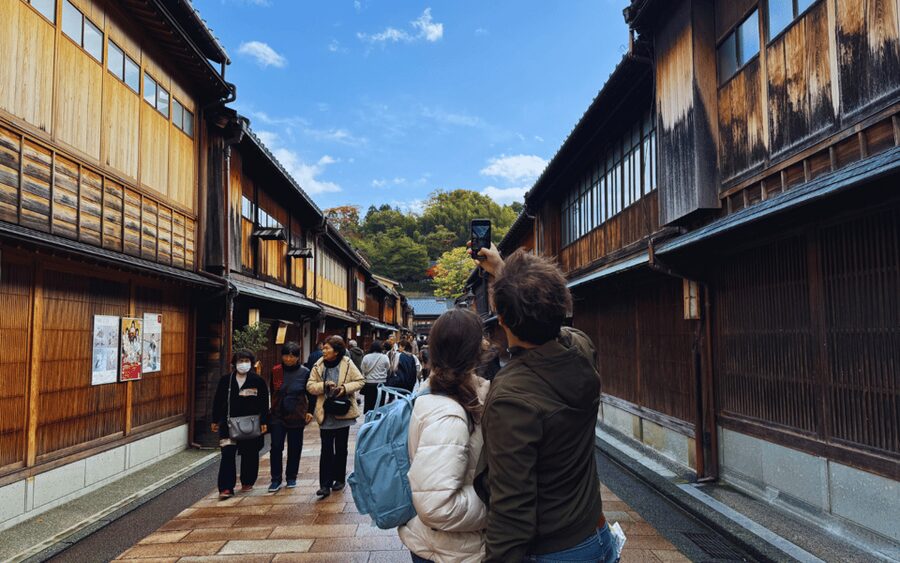
Higashi Chaya gives the tour its most atmospheric finish. The historic teahouse district has wooden facades, narrow streets, craft shops, and places connected with traditional entertainment. This is where Kanazawa’s artistic side becomes tangible.
You can look for Kutani ware, gold leaf art, and local sake. Gold leaf is especially associated with Kanazawa, and the district offers a chance to see how that craft appears in objects made for everyday use and decoration. A stop for gold leaf ice cream may also be suggested, based on the guide’s local food recommendations, but it should be treated as a possible tip rather than a guaranteed part of the tour.
Shopping is included in this section, but the value is not limited to buying souvenirs. A guide can explain what you are looking at and help separate a local craft from a generic gift-shop object. If you are interested in ceramics, gold leaf, or sake, tell your guide before arriving so the hour is used well.
There are optional visits to Shima or the Ochaya Art Museum for a closer look at teahouse culture and related art. These are not presented as required stops, and four hours may not allow a long visit to both. Ask your guide how to fit one in if the interiors matter more to you than shopping or street photographs.
The district is also the finishing point, which is convenient. You can continue exploring Higashi Chaya after the formal tour without having to retrace the route. Since the final stop is at the teahouse quarter, ask your guide for ideas for lunch or dinner before saying goodbye. Megumi, in particular, has helped guests with meal recommendations, while other guides have offered snack tips and local suggestions.
What the private guide adds
The strongest reason to choose this experience is the guide rather than the admission tickets. The parks and districts can be visited independently, but the right guide turns a sequence of attractive places into a connected story.
Megumi has been praised for clear explanations of traditions, architecture, and local customs, along with careful attention to comfort and pacing. Lee Stephen brings an engaging, sometimes playful approach and has a background as a school teacher. Gucci has introduced visitors to Kanazawa’s history and regional crafts, while Sho has provided useful historical background within the four-hour format.
Those names do not guarantee who will lead your tour. The guide assigned to you may be different. Still, they show the kind of service this private format is built to provide: explanation, conversation, and adjustment instead of a fixed speech delivered to a large group.
That flexibility is useful in real conditions. In rain, one guide shifted the plan, arranged time in a teahouse, and used a restaurant to wait out the worst weather. Another adapted the route when the group had already visited one area. You should not expect every request to be possible, but private touring gives you a better chance to shape the morning around weather, interest, and energy.
Is $150 per person fair?
At $150 per person, this is not the cheapest way to see Kanazawa. You are paying for a private English-speaking guide, admission to the listed sights, route planning, and the ability to ask questions without competing with a large group.
The value improves when you are traveling as a small family or group and care about context. A guide can explain garden design, connect castle structures with the city’s past, and help you make sense of local crafts. The tour can also save time, since the major stops are arranged in a logical order and linked by a short bus transfer.
The value is weaker if you only want photographs or prefer to wander alone. Oyama Shrine, Kanazawa Castle Park, Kenrokuen, and Higashi Chaya can be visited without a guide. In that case, the admission inclusions may not justify the full price by themselves.
For families and first-time visitors, I think the private format is the main advantage. For repeat visitors, it makes more sense if you want a craft-focused, food-focused, or history-focused route. Mention your interests when booking or at the start, since the schedule is short and the guide can make better choices with that information.
Free cancellation up to 24 hours before the start and reserve-now, pay-later booking also reduce the risk when your Japan plans are still moving. Those policies are useful, but the more important practical question is whether you are comfortable walking outdoors for most of the four hours.
Who should book this tour?
I would recommend it to first-time visitors who want Kanazawa’s major cultural sights without spending a full day on a broad city tour. It also suits families, couples, and small groups who prefer conversation and flexible pacing.
It is a good match if you want:
- A compact introduction to Kanazawa’s gardens and historic districts
- English explanations of architecture, customs, and crafts
- Help choosing local snacks, restaurants, or shopping stops
- A private schedule that can respond to rain or prior sightseeing
- A route ending in Higashi Chaya, where you can continue on your own
Think twice if you use a wheelchair, have limited mobility, or dislike walking on garden paths and castle grounds. Smoking is not allowed, and the experience is offered in English only.
Final verdict: a strong first look at Kanazawa
Book this tour if you want the main Kanazawa sights tied together by a person who can explain what you are seeing. The route is well balanced, moving from Oyama Shrine to castle grounds, Kenrokuen, and Higashi Chaya without wasting the limited half-day.
The best reason to choose it is the chance to make four hours feel personal. Ask for garden design, local crafts, restaurant ideas, or a slower pace at the stops that matter most to you. Skip it if you prefer unstructured wandering or need a fully accessible route. For everyone else, $150 per person is a reasonable price for a focused private introduction to Kanazawa.
FAQ
How long does the Kanazawa private tour last?
The tour lasts four hours.
Where does the tour begin?
Meet in front of the Shinmon Gate of Oyama Shrine. The guide will hold a yellow sign with the DeepExperience logo.
Where does the tour finish?
The tour finishes in Higashi Chaya District.
What language is the tour offered in?
The live guided tour is offered in English.
Is the tour private?
Yes. It is arranged for a private group.
What admissions are included?
Admission to Oyama Shrine, Gyokusen’inmaru Garden, Kanazawa Castle Park, Kenrokuen Garden, and Higashi Chaya District is included.
Is transportation included during the tour?
A bus or coach transfer of about 10 minutes is included between Kenrokuen and Higashi Chaya.
Is the tour suitable for wheelchair users?
No. The experience is not suitable for wheelchair users or people with mobility impairments. Comfortable shoes, water, a hat, sunscreen, and a camera are recommended.
Newly planted garden visits around Japan
- Stunning Private Tea Ceremony: Camellia Garden Teahouse★ 5.0 · 28 reviews
- Kyoto-Nara Adventures Private Tour With Hotel Pick Up★ 4.0 · 5 reviews
- Kyoto: Kinkaku-ji Temple & Serene Garden Guided Tour with Tickets★ 5.0 · 9 reviews
- Guided Kyoto City Cherry Blossom One Day Private Tour★ 5.0 · 16 reviews
- Kyoto Hidden Treasures: Special Temple & Garden Access Tour★ 4.5 · 25 reviews
- The Art of Mindful Living: Tea Ceremony in Kyoto★ 5.0 · 16 reviews
- Kyoto ITALIAN GUIDE Golden Pagoda Bamboo Forest Dry Garden★ 4.0 · 2 reviews
- Kyoto Japanese Garden Lover’s Private Tour with Government-Licensed Guide★ 4.5 · 10 reviews
Japan Garden Tours, bed by bed.

Imperial Palace East Garden and Edo Castle Walking Tour in Tokyo
Read our review →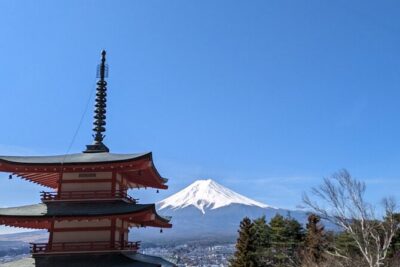
Mt. Fuji Day Trip from Tokyo with English Speaking Driver Guide
Read our review →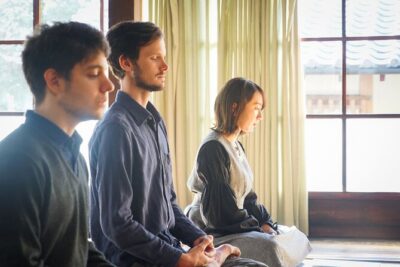
Kyoto Zen Meditation & Garden Tour at a Zen Temple with Lunch
Read our review →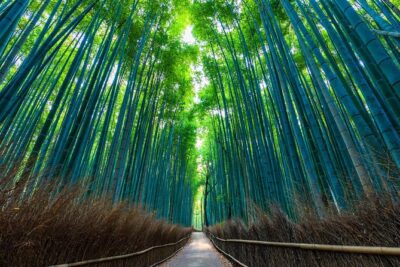
Kyoto Arashiyama Bamboo forest & Garden Half-Day Walking Tour
Read our review →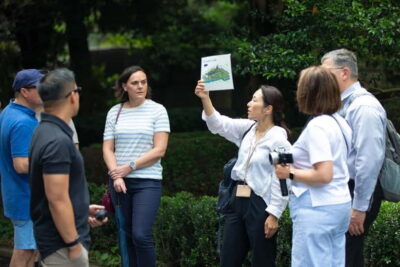
Tokyo: Imperial Palace East Gardens Walking Tour
Read our review →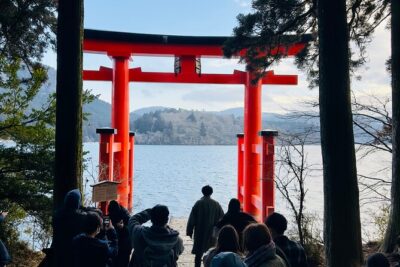
Kyoto Kiyomizu Tea Ceremony with Scenic Garden Views
Read our review →Lists this garden visit belongs to