
Review · INDIA
Flower Market Colors and Ganges Ghat Experience
Kolkata’s Malik Ghat Flower Market is at its best early, when flower sellers unload heaps of marigolds and roses beneath the shadow of Howrah Bridge. I like the way this tour puts you inside the working market, then carries you to the Hooghly River for prayers, bathing, and everyday river life. The included hot chai in an earthen cup is a small but fitting touch.
I also like the private format. Guide Kaushik is praised for clear explanations, practical help, and adding extra stops when time allows. The main trade-off is simple: you must reach the 6:30 am meeting point yourself, since private transportation is not included, and the market can be crowded, wet, noisy, and rough around the edges.
Key points to know before you book
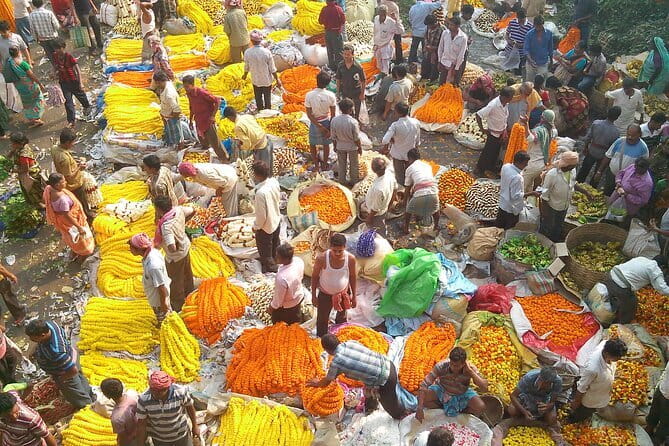
- Malik Ghat at dawn: See Kolkata’s main wholesale flower market while traders sort and sell fresh blooms.
- Howrah Bridge overhead: Spend time beneath one of Kolkata’s defining landmarks as city traffic and commerce gather around it.
- Hooghly River rituals: Watch bathing, prayers, and ceremonies along the busy ghats.
- Private guiding: Your group travels alone, allowing the pace and explanations to suit your interests.
- Short morning format: The experience lasts about two to three hours and ends at Mullick Ghat Flower Market.
- Good value at $30: The price includes a guide, tea or coffee, and entry to the described stops, but not transport or gratuities.
Why the flower market is the real reason to go

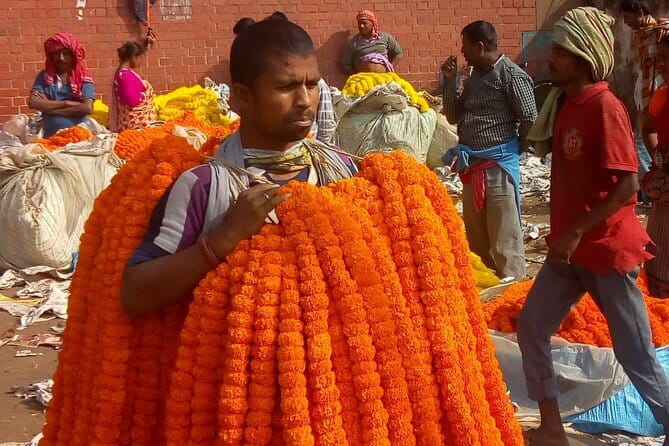
The first stop, Malik Ghat Flower Market, is the heart of the experience. This is not a tidy market arranged for sightseeing. It is a working wholesale bazaar, where flowers arrive early and move quickly through the hands of sellers, buyers, porters, and worshippers.
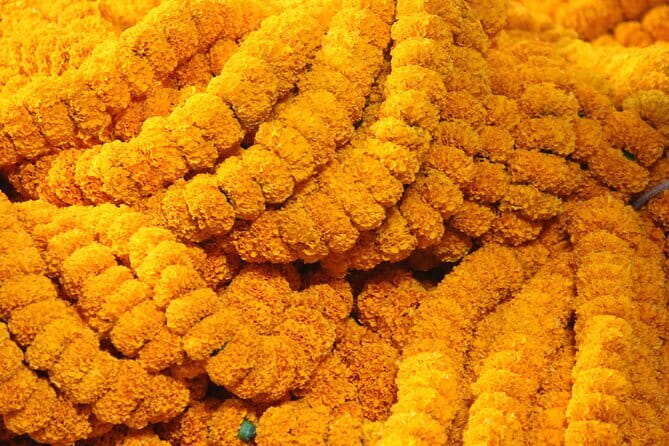
You can expect piles of yellow and orange marigolds, roses, and other flowers spread across the market. The colors are strong, but the setting is just as important: narrow paths, quick bargaining, heavy loads, and the constant movement of people who are there to earn a living.
I like this kind of stop because it gives you a useful view of Kolkata beyond monuments. Flowers here are part of business, worship, ceremonies, and daily routine. You are not simply looking at pretty displays. You are seeing a market that serves the city’s religious and social life.
The scheduled market visit lasts about an hour. That is enough time to get a sense of its scale and rhythm without turning the whole morning into a long walk through one crowded area. Your guide can also help you notice details that are easy to miss when you arrive alone, such as how the flowers are grouped, sold, carried, and connected to the rituals along the river.
There are practical drawbacks. The ground may be uneven, the walkways can feel tight, and the early hour means you should dress for a fast start rather than a leisurely breakfast. The setting is also active and commercial, so anyone seeking a polished or quiet attraction may find it overwhelming.
For photographers, this is likely the strongest part of the morning. Dawn light, flowers, workers, and the old structures around the ghat create plenty to frame. Still, ask before photographing people at close range, especially during religious activity.
More Flower Markets and Flower Fields in India
- Jaipur Tuk-Tuk Tour with Flower Market Visit
★ 5.0 · 124 reviews - Jaipur Tour by Tuk-Tuk or Car with Flower Market
★ 5.0 · 120 reviews - Jaipur: Half-Day Guided Sightseeing Tour with Flower Market
★ 4.9 · 119 reviews
Howrah Bridge gives the market its setting
After the flower market, the tour spends about 20 minutes at Howrah Bridge. The bridge is not treated as an isolated viewpoint. It is part of the same working zone, with traffic, pedestrians, river activity, and business pressing around it.
That matters because the bridge helps explain the scale of Kolkata. From below and around the market, you see a landmark that is also a daily route for the city. It is not merely something to photograph from a distance. It helps frame the relationship between the river, the market, and the people moving through this part of town.
The stop is short, so do not expect a long architectural tour. Instead, use it as a pause for photographs and orientation. Your guide can point out how the bridge relates to the ghats and market area, giving the morning a clearer sense of place.
I like the combination of the first two stops. The flower market supplies the close-up detail, while Howrah Bridge provides the wider view. You get color and human activity first, then a landmark that shows how much of Kolkata’s movement is concentrated around the river.
Because this is a walking experience with several nearby points of interest, comfortable shoes matter more than dressy clothes. The tour does not include private transportation, so you should plan your route to the meeting point in advance. The stated start is 6:30 am at K.C. Das, 11A and B Central Avenue, near Esplanade, Chowringhee North, Bow Barracks.
The Hooghly shows Kolkata at prayer and work
The next stop is the Hooghly River, described here as the Ganges in Kolkata. You spend about 30 minutes along the ghats, where the river supports religious ceremonies and ordinary city life at the same time.
You might see people bathing, offering prayers, or taking part in ceremonies for the departed. The scene changes from the market’s loud trade to a more reflective setting, though it is not necessarily quiet. The ghats remain active, and the river is part of the city’s daily routine rather than a distant backdrop.
This is where a guide adds real value. Religious actions can be easy to misread if you do not know what you are seeing. A clear explanation can help you understand the difference between a private moment, a public ritual, and an everyday act of devotion. The information provided about Kaushik is especially useful here: he is described as clear, accommodating with time limits, and willing to add stops when possible.
I would keep your camera ready but your behavior respectful. The best photographs may come from the wider setting, with the river, ghat steps, bridge, and people placed together. Avoid treating ceremonies as staged scenes. Give people room and follow your guide’s advice.
The river stop also keeps the tour from becoming only a market visit. You see how commerce, worship, transport, and neighborhood life meet along one stretch of Kolkata. That mix is the strongest reason to choose this experience over a quick independent walk through the flower stalls.
Mallick Ghat adds smaller details
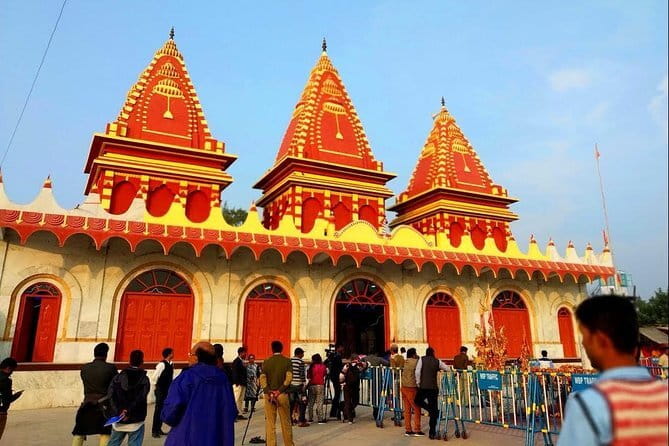
The final stop is Mallick Ghat, scheduled for about 10 minutes. It includes views of an adjacent former ladies’ bathing ghat, iron scaffolding brought from England, and pigeon feeding.
This is a short stop, but it gives the morning a few specific details that could easily disappear in the larger scene. The former ladies’ bathing area points to the social organization of the ghats, while the ironwork adds a reminder of the area’s older construction and industrial connections.
Pigeon feeding is another small piece of local routine. It may not sound like a major attraction, but these brief observations are often what make a walking tour feel grounded. You are not simply moving between famous names. You are being shown how the space is used.
The stop is too brief for a detailed architectural visit, so keep your expectations in check. Think of it as a final cluster of observations before the tour ends, not a separate major attraction.
The listed end point is at the Mullick Ghat Flower Market entryway on Strand Bank Road, Fairley Place, in B.B.D. Bagh. In special cases, the guide may escort you back toward the original meeting point when possible, but you should not count on that as included transport.
Same season, a different set of beds:
- Private Jaipur Full-Day Tour with Block Printing
★ 5.0 · 206 reviews - Private Custom Full Day Sightseeing Tour of Kolkata
★ 5.0 · 128 reviews - Jaipur: Half or Full Day Sightseeing Tour with Flower Market
★ 5.0 · 94 reviews - Delhi: Yoga in Lodhi Garden
★ 4.9 · 53 reviews
What the private format changes

This is a private tour, meaning only your own group participates. That is useful in a market where a large group would be hard to keep together and awkward around sellers and worshippers.
A private guide can also adjust the morning to your interests. If you care most about photography, you can spend more attention on light, color, and composition. If you want more explanation about religious practices, the river and ghats can receive greater focus. The available information describes Kaushik as flexible with time constraints and willing to include additional stops when possible.
That flexibility is a genuine advantage, but it depends on the guide and the time available. The stated program is already full for a two to three hour morning, so extra stops should be treated as a possibility rather than a promise.
The experience is described as suitable for most participants and close to public transportation. Still, you should be ready for an early start, walking, crowds, uneven surfaces, and an active working environment. The tour does not list private vehicle service, so this is best understood as a guided walking experience from the meeting point to the market and river area.
Is $30 a fair price?
At $30 per person, the tour offers reasonable value if you want a guide to interpret the market and ghats rather than simply point them out. Your fee covers the guide, the listed stops, and hot tea or coffee. You also get a private format, which can make the cost more attractive for a small group that wants personal attention.
The price does not include transportation, personal expenses, or gratuities. That means you should add the cost and effort of getting to K.C. Das at 6:30 am. Since the tour ends in a different area, you should also plan your onward route from Mullick Ghat.
For a solo visitor, $30 is mainly paying for context and ease. You could reach the market independently, but you would need to find your way around a crowded working bazaar and make sense of the river rituals on your own. For two or more people, the private arrangement can feel like a better deal, especially if group discounts apply to your booking.
I would choose this tour for the guide and access to local detail, not for included transport or a long list of attractions. The program is compact, so the value comes from how well the guide explains what you are seeing.
Best time, meeting point, and practical preparation
The tour starts at 6:30 am. That early hour is essential to the experience because the flower market is already active while the day is beginning. Arriving late could mean missing part of the most energetic period.
Meet at K.C. Das, 11A and B, Central Avenue, Esplanade, Chowringhee North, Bow Barracks, Kolkata, West Bengal 700069. The tour ends at the Mullick Ghat Flower Market entryway, 223 Strand Bank Road, Fairley Place, B.B.D. Bagh, Kolkata 700001.
Wear shoes that can handle a working market and riverfront paths. Bring only what you need, keep valuables secure, and leave room for the fact that your clothing may encounter dust, water, or flower debris. The included tea is served hot in a disposable earthen cup, a pleasant way to warm up during the early morning.
The booking confirmation is normally issued at once, though reservations made within one day of departure may need to wait for availability. Free cancellation is available up to 24 hours before the start time. Changes or cancellations inside that period are not accepted for a refund.
Who should book this morning walk?
I would recommend it to first-time visitors who want a strong introduction to Kolkata through working places rather than formal attractions. It also suits photographers, people interested in religious life, and anyone who prefers a small private group to a large scheduled party.
It is a good choice if you want several connected experiences in one morning: the flower trade, Howrah Bridge, the Hooghly ghats, and smaller local details at Mallick Ghat. The guide’s role is important, especially if you want more than attractive photographs.
I would hesitate if you dislike early starts, crowded markets, walking, or religious scenes that may be visually intense. You should also choose another option if private transportation is essential or if you want a relaxed tour with long stops and plenty of time for breakfast.
Should you book the Flower Market Colors and Ganges Ghat Experience?
Book it if you want to see Kolkata waking up through its flower sellers, river rituals, and daily commerce. At $30, the private guide and focused morning route offer solid value, particularly for a small group.
The best reason to go is the combination of Malik Ghat and the Hooghly. The market gives you color and motion, while the river adds prayer, bathing, and a more personal view of the city. Just arrive ready for a rough-edged working environment, arrange your own transport to the meeting point, and keep your expectations centered on local life rather than polished sightseeing.
FAQ
How long does the Flower Market Colors and Ganges Ghat Experience last?
The experience lasts approximately two to three hours. The listed stops include about one hour at Malik Ghat Flower Market, 20 minutes at Howrah Bridge, 30 minutes at the Hooghly River, and 10 minutes at Mallick Ghat.
What time and where does the tour start?
The tour starts at 6:30 am at K.C. Das, 11A and B, Central Avenue, Esplanade, Chowringhee North, Bow Barracks, Kolkata, West Bengal 700069, India.
Where does the tour end?
It ends at the Mullick Ghat Flower Market entryway at 223 Strand Bank Road, Fairley Place, B.B.D. Bagh, Kolkata, West Bengal 700001, India. In special cases, an escort back toward the original meeting point may be possible.
Is transportation included?
Private transportation is not included. The experience is near public transportation, and you are responsible for reaching the starting point and arranging onward travel from the ending point.
Is this a private tour?
Yes. Only your group participates. Group discounts may be available.
What is included in the price?
The $30 price includes a guide and hot coffee or tea, served in an earthen disposable cup. Personal expenses and gratuities are not included.
Newly planted garden visits around India
- Private Custom Full Day Sightseeing Tour of Kolkata★ 5.0 · 128 reviews
- Kolkata’s Flower Market – Hooghly’s Flower Fest Tour★ 5.0 · 35 reviews
- Mandore Garden Walking Tour★ 4.0 · 2 reviews
- Jaipur City Tour with Traditional Flower Market Visit★ 5.0 · 7 reviews
- Jaipur Full-Day Heritage Tour with Guide★ 5.0 · 18 reviews
- Jaipur Sunrise Tour with Morning Flower Market Walk★ 5.0 · 16 reviews
- Jaipur Half-Day Tour with Flower Market and Block Printing★ 5.0 · 4 reviews
- Jaipur Tour with Monkey Temple and Block Print Experience★ 5.0 · 6 reviews
Flower Markets and Flower Fields, bed by bed.
Bangkok: Night Bike Tour with Temples & Flower Market Visit
Read our review →
Keukenhof: Flower Fields Small-Group Cultural Bike Tour
Read our review →
Kolkata’s Flower Market – Hooghly’s Flower Fest Tour
Read our review →
Amsterdam: Half-Day Flower Fields and Keukenhof Bicycle Tour
Read our review →
Flower Market & Floral Art: Multilingual Private Tour [EN/others]
Read our review →
Cebu: City Highlights with Sirao Flower Garden Visit
Read our review →
Bangkok Wat Pho and Flower Market Historical Walking Tour
Read our review →
Lists this garden visit belongs to