
Review · PORTUGAL
Sintra: National Palace and Gardens Skip-the-Line Ticket
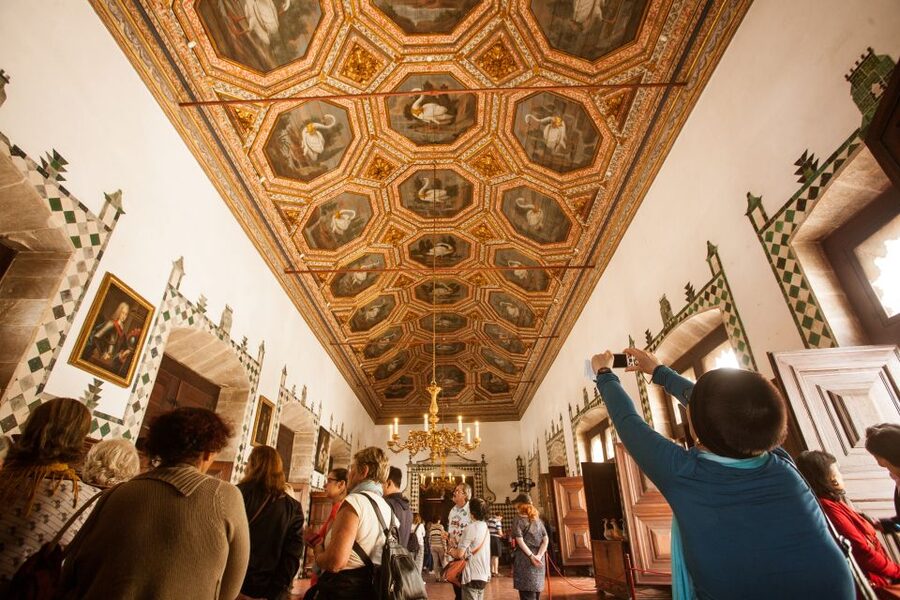
Sintra’s National Palace is the town’s most rewarding history lesson, with twin white chimneys, tiled rooms, royal courtyards, and architectural details shaped by Moorish, Gothic, and Manueline taste. It is the best-preserved medieval royal palace in Portugal, and the story here reaches back roughly 1,000 years.
I like the freedom to move at your own pace, and I like the free multilingual audio guide, which helps explain rooms that can otherwise feel like a procession of beautiful tiles and staircases. The main catch is that this is an entry ticket, not a guided tour, and the skip-the-line benefit may be modest when crowds are light.
Key points to know
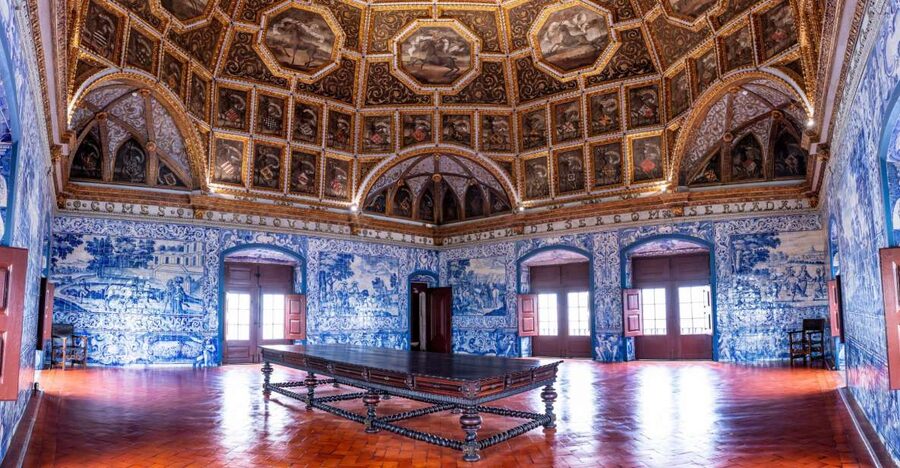
- See the Heraldic Room and Chapel: These are among the palace’s most memorable interiors, with royal symbolism, painted decoration, and impressive craftsmanship.
- Follow a thousand years of building work: The palace began as a Moorish fortress and changed under Portuguese kings and queens.
- Look closely at the tilework: Geometric glazed tiles, Manueline decoration, and Mudejar design give each courtyard and room a different character.
- Use the audio guide: It is available through an app in Portuguese, English, Spanish, and French.
- Allow about an hour or a little more: That is enough for a focused visit, but extra time helps if you want the gardens and a slower look at the interiors.
- Plan around Sintra’s crowds: The palace can be easier to enter than Pena Palace, but busy afternoons and summer days can still feel crowded.
Why the National Palace deserves a place in your Sintra day
Many people come to Sintra for the fairy-tale colors of Pena Palace. The National Palace offers a different reward. Its charm is not based on one dramatic viewpoint or a single grand facade. Instead, you move through a working royal residence shaped over centuries, where Moorish patterns, Portuguese tiles, Gothic forms, and Manueline flourishes sit side by side.
The palace began as a Moorish castle after the Umayyad conquest of Hispania in the eighth century. After the Christian conquest of Sintra, the first king of Portugal extended the fortress in 1147. Later rulers added rooms, chapels, courtyards, kitchens, and ceremonial spaces.
That long building story gives the visit its structure. You are not simply looking at one palace built at one time. You are following the changes made by different rulers, each adapting the building to new needs and tastes.
I especially like this palace for visitors who want history without committing to a full guided day. The ticket lets you enter, take your time, and use the app when you want context. You can pause in a courtyard, skip a room that does not interest you, or spend longer with the tilework.
More Palace and Castle Gardens in Portugal:
- Queluz: National Palace and Gardens E-Ticket & Audio Guide
★ 4.5 · 46 reviews - National Palace and Gardens of Queluz: E-ticket with Audio Guide
★ 3.5 · 6 reviews - Paris: Versailles Palace and Gardens Full Access Ticket
★ 4.6 · 41,579 reviews
Entering the palace without a long ticket queue
The ticket is valid for one day, with palace opening hours listed as 9:30 AM to 6:00 PM and last admission at 5:30 PM. You should check the current hours before setting out, since access and closing times can change.
The skip-the-line feature is most useful during busy periods. In quieter months, early mornings, late afternoons, Mondays, or certain off-season dates, there may be little or no queue. Several visits have found the palace much easier to enter than Pena Palace, so do not assume that a fast-track ticket will always save substantial time.
Still, buying ahead has a practical benefit. You can go directly to the entrance rather than spending time finding a ticket office in a crowded town. Keep your ticket ready, and pay close attention to signs. Entry directions have caused confusion, especially for people visiting more than one Sintra monument on the same day.
The National Palace is in central Sintra, but transportation is not included. You need to arrange your own way to town and between Sintra sights. That matters because a day combining Pena Palace, the Moorish Castle, Quinta da Regaleira, and the National Palace can become a race against closing times.
The courtyards reveal Sintra’s mixed design

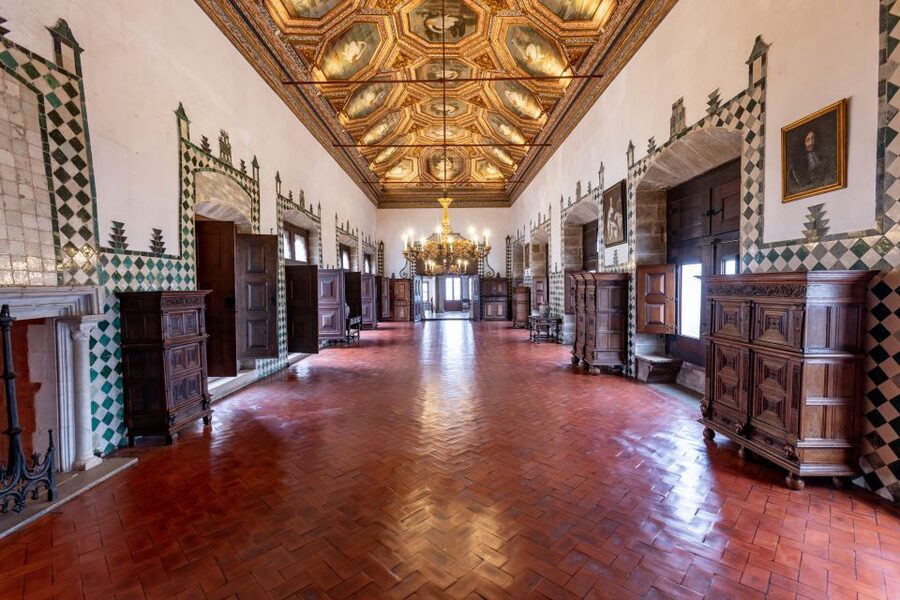
The first major pleasure is simply walking from one courtyard to the next. The building uses its sloping setting and irregular shape well, so the route never feels like a plain rectangular museum.
Look for Manueline details, the elaborate Portuguese style associated with the late fifteenth and early sixteenth centuries. You will also see Mudejar influence, especially in the patterned tilework, arches, and water features.
The glazed tiles are a major reason to visit. Blue and white surfaces, geometric patterns, and decorative walls turn practical spaces into works of art. The tiles are not confined to one showcase room, so keep looking around corners and along stairways.
The palace’s windows are another detail worth slowing down for. Many have surmounted arches and decorative framing that show how Moorish design continued to influence Portuguese architecture. The effect is subtle in some places and wonderfully theatrical in others.
The courtyards also help you understand daily palace life. Water features were not merely decoration. They cooled and enlivened enclosed spaces, while the arrangement of rooms around them created a sense of separation between public ceremonies and private life.
The Heraldic Room, Chapel, and royal interiors
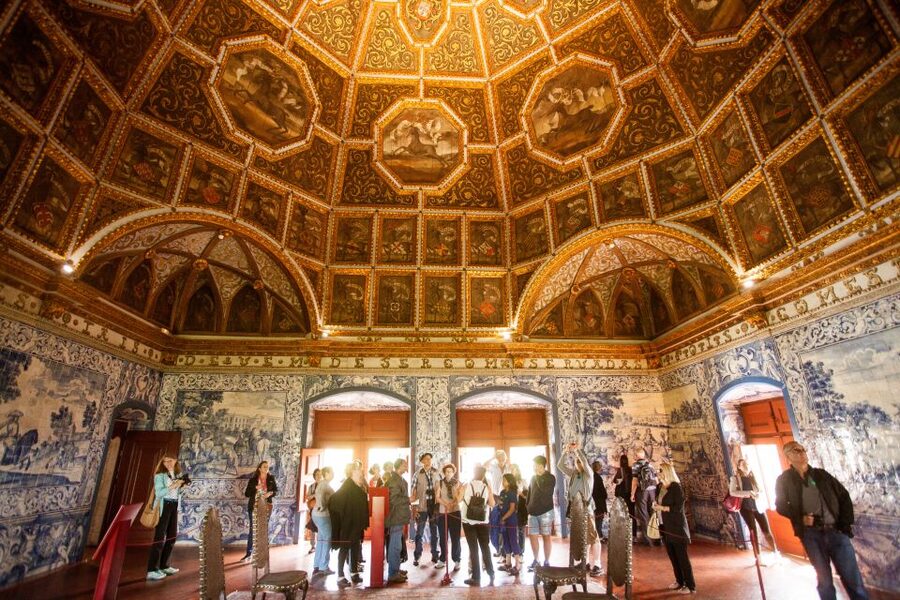
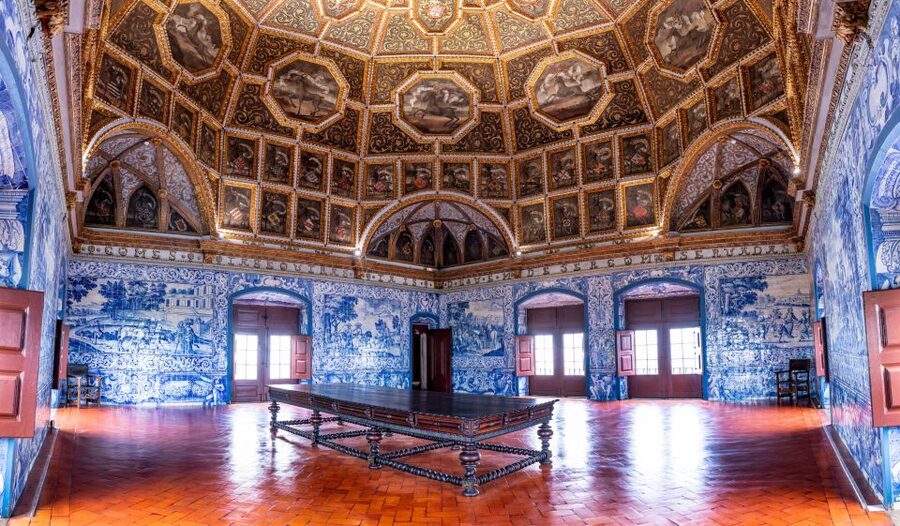
The Heraldic Room is an unexpected highlight. Its decoration focuses on Portuguese noble families and royal authority, making it far more than a pretty chamber. Give yourself time to look upward and around the walls rather than walking straight through.
The Chapel offers a quieter stop. Its scale and decoration show the religious side of court life, while the palace rooms nearby reveal the ceremonial and domestic sides. Together, these spaces make the building feel inhabited rather than merely preserved.
You will also pass through rooms with furniture, artwork, staircases, and decorative features from different periods. The variety is part of the appeal, though it can also make the visit feel less tidy than a palace designed in one age. That is historically honest, but it means you should use the audio guide to connect the pieces.
The kitchens are particularly interesting if you enjoy the practical side of royal life. Large palace kitchens help you picture the staff needed to feed a court, and they add balance to the more formal rooms. You are not only seeing where royalty appeared in public. You are also getting hints of the cooks, servants, and workers who kept the residence functioning.
Skip-the-line garden entries around Portugal:
- Versailles: Skip-the-Line Tour of Palace and Gardens Access
★ 4.7 · 10,429 reviews - Vienna: Schönbrunn Palace & Gardens Skip-the-Line Tour
★ 4.7 · 7,739 reviews - Vienna: Skip-the-Line Sisi Museum, Hofburg and Gardens Tour
★ 4.8 · 5,918 reviews - Vienna: Skip-the-Line Schönbrunn Palace & Gardens Tour
★ 4.8 · 5,411 reviews
A new audiovisual route about palace life
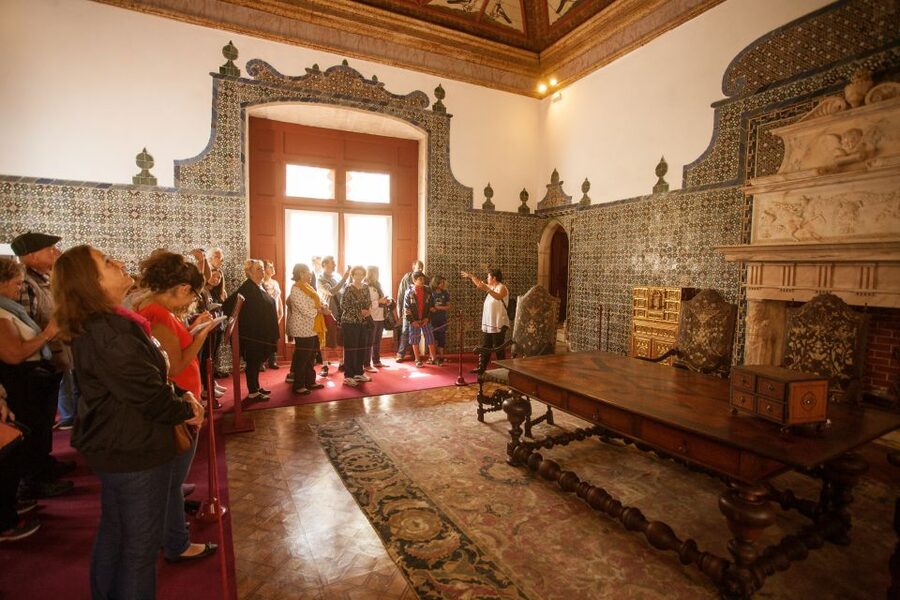
The newer audiovisual addition adds a human angle to the visit. Short films placed along the route introduce 14 historical figures, including queens and cooks. The portraits are presented in Portuguese and English and use voices from well-known Portuguese actors.
This matters because palace history can otherwise focus too heavily on kings, dates, and architecture. The audiovisual material brings attention to the people who lived and worked inside the building, including figures whose stories are easier to overlook.
The films are designed to fit into the normal visit rather than replace it. You can combine them with the app audio guide, the virtual tour, and the treasure hunt tools available at the palace. If you prefer a quiet, self-directed visit, you can focus on the rooms and use only the parts of the digital material that interest you.
Because the ticket does not include a live guide, these tools provide much of the interpretation. They are useful, but they do not offer the give-and-take of a private or small-group tour. If you want to ask questions as you go, you should consider booking a separate guided option instead.
How long to spend inside
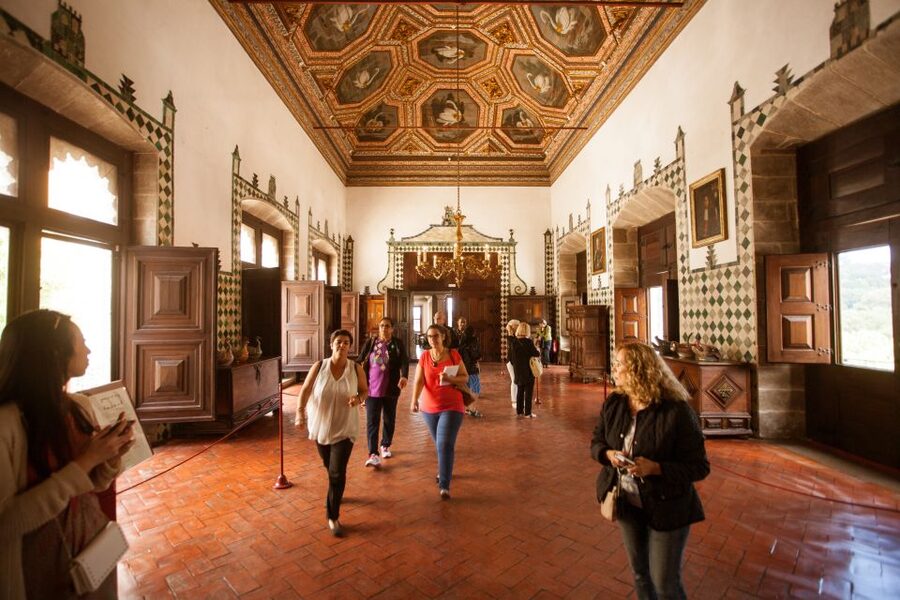
You can see the main palace route in about an hour and a little more. That shorter visit works well if you have only a few hours in Sintra or are using the National Palace as one part of a larger day.
I would allow closer to two hours if you want to read the information, listen to the audio guide, watch the new films, and enjoy the gardens without rushing. The exact time depends on how much of the digital material you use and how crowded the route is.
Do not make the common mistake of spending too long at an earlier attraction and reaching the palace near closing. One visit ran out of time for the gardens after a longer stop at Pena Palace. If the National Palace is important to you, schedule it early enough that you are not watching the clock.
The palace involves stairs and walking up and down uneven sections. One direct warning from past visitors is worth taking seriously: the site can be difficult if you have mobility limitations, especially because access and handrails are limited in some areas.
Palace gardens and what to expect outside
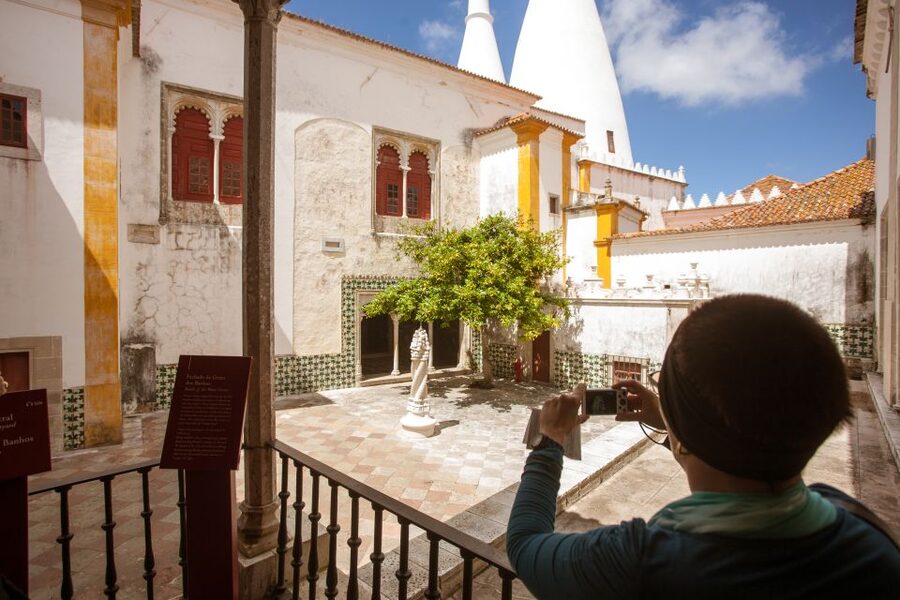
The gardens are part of the attraction, but they are not the main reason to buy this ticket. The interiors, tilework, royal rooms, chapel, kitchen, and courtyards carry most of the visit.
Some people find the gardens less impressive than other Sintra sights. Others enjoy ending the visit outdoors after the tighter interior route. If you have time, take a walk through them, but do not expect the dramatic scale or sweeping theatrical views associated with Pena Palace.
Watch the closing time carefully. Garden access has not always matched the time listed elsewhere, and an early closure can leave you with less time than expected. Confirm the day’s schedule before arrival, particularly outside the main summer season.
Using the audio guide well
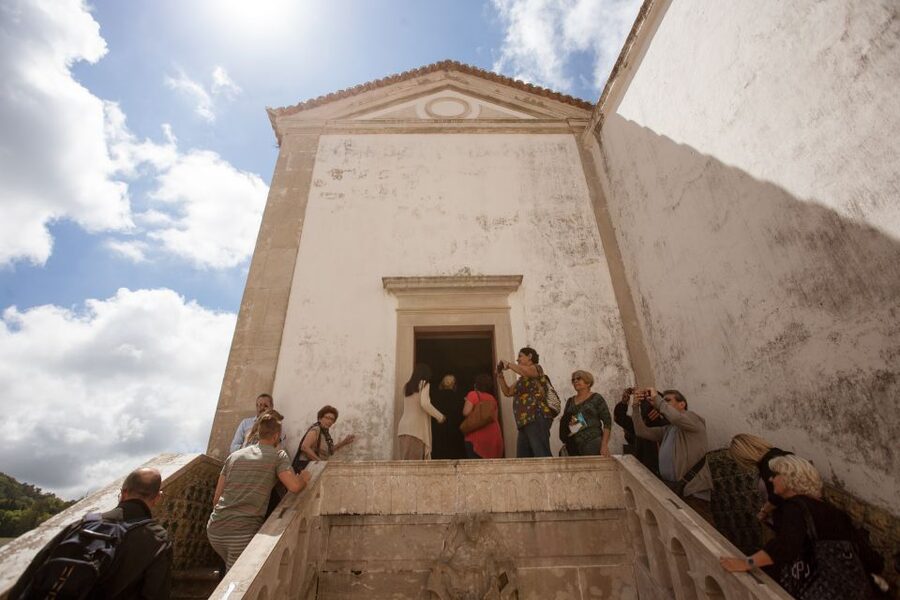
The free audio guide is available in Portuguese, English, Spanish, and French. Download or prepare to access the app before you enter if possible, and bring enough phone battery for the visit.
I like the audio option because it gives the palace a clear order without forcing you to stay with a group. Use it for the Heraldic Room, chapel, major courtyards, and the palace’s building history. For smaller rooms, you may prefer to look around first and then listen.
The guide is also helpful when the palace is crowded. Rather than waiting for a live guide to finish speaking, you can move to the next room and return to a section later. On the other hand, app-based guiding can be less personal, and you may need to stop often to follow the route.
Is the $15 price good value?
At $15 per person, this is a sensible purchase for a self-guided palace visit. The price is low compared with a guided tour, and the ticket includes the audio guide rather than charging extra for basic interpretation.
The value is strongest when you want a flexible visit and have limited time. You get direct entry, access to one of Portugal’s most important monuments, and enough material to understand the building without paying for a full tour.
The value is weaker if you are visiting during a quiet period when there is no queue. In that case, the skip-the-line feature may not save much. It is also less compelling if you have room for only one Sintra monument and care most about dramatic views, since Pena Palace or another major site may better match that preference.
Still, the National Palace is usually a calmer and more manageable choice than Pena Palace. It can be easier to enter, less overwhelming, and more practical for a short visit in central Sintra.
Who should book this ticket?
I would recommend it to you if you enjoy architecture, royal history, tilework, and self-guided sightseeing. It is a good fit for families or couples who do not want to remain with a tour group, and for anyone trying to fit one worthwhile monument into a tight Sintra schedule.
You should think twice if you dislike stairs, have serious mobility concerns, or want a guide who can answer questions in person. The palace is not a quick, fully accessible stroll, and the ticket does not include transportation, food, drinks, or a live guide.
The overall rating is 4.3 from 1,144 bookings, which fits the experience well: the palace itself is widely appealing, while the practical details can vary with crowds, signs, opening times, and the usefulness of the skip-the-line entry on your date.
Should you book the National Palace ticket?
Book it if you want a beautiful, historically layered palace with excellent tilework and a flexible one-day ticket. Make it your first Sintra stop if you have limited time, and allow at least an hour, preferably more if you want the gardens and digital features.
Skip it only if your priority is a dramatic hilltop setting or sweeping views. For royal rooms, Moorish and Manueline details, the Heraldic Room, the chapel, and a clearer sense of everyday court life, this $15 visit is one of Sintra’s better-value choices.
FAQ
Where is the National Palace of Sintra?
The palace is in Sintra, in Portugal’s Lisbon District.
How much does the ticket cost?
The listed price is $15 per person.
How long is the ticket valid?
The ticket is valid for one day.
What are the palace opening hours?
The listed opening hours are 9:30 AM to 6:00 PM, with last admission at 5:30 PM. Check the hours before visiting.
Does the ticket include a guided tour?
No. A live guided tour is not included.
Is an audio guide included?
Yes. A free audio guide is available through an app.
Which audio guide languages are available?
The audio guide is available in Portuguese, English, Spanish, and French.
Is transportation included?
No. You must arrange your own transportation.
Are food and drinks included?
No. Food and drinks are not included.
Can I visit the palace gardens with this experience?
The experience is described as a National Palace and Gardens ticket, and the visit includes access to the palace grounds and gardens. Garden closing times may differ, so check the schedule on the day.
Is the activity refundable?
No. The activity is non-refundable.
Newly planted garden visits around Portugal
- Sunday Market and Gardens Tour★ 4.0 · 10 reviews
- Botanical Trails of Madeira. Mountain biking Trail Experience★ 5.0 · 42 reviews
- Monte Tropical Garden & Toboggans private Tuk-Tuk tour★ 5.0 · 25 reviews
- Funchal Old Town & Palheiro Gardens Private Tuk Tuk Tour★ 5.0 · 8 reviews
- Madeira Botanical Gardens and Old Town Tuk Tuk Tour by MadTuk★ 4.5 · 7 reviews
- Buddha Eden Garden and Óbidos village in Portugal (70km of Lisbon)★ 5.0 · 23 reviews
- Tour fantastic time with us and meet all the coners of this garden near the sea★ 4.5 · 7 reviews
- National Palace and Gardens of Queluz: E-ticket with Audio Guide★ 3.5 · 6 reviews
Palace and Castle Gardens, bed by bed.
Paris: Versailles Palace and Gardens Full Access Ticket
Read our review →Versailles: Skip-the-Line Tour of Palace and Gardens Access
Read our review →
Vienna: Schönbrunn Palace & Gardens Skip-the-Line Tour
Read our review →
Granada: Alhambra & Gardens Tour w/Nasrid Palaces Option
Read our review →
From Paris: Versailles Palace & Gardens with Transportation
Read our review →
Florence: Reserved Entry Ticket to the Boboli Gardens
Read our review →
From Paris: Versailles Palace Guided Tour & Gardens Access
Read our review →Versailles Palace and Gardens Tour from Paris
Read our review →Lists this garden visit belongs to