
Review · SOUTH KOREA
Full-day Hadong, Gwangyang, Cherry blossom, Green Tea Fields Private Tour
The best part of this full-day trip is its mix of Hadong’s April cherry blossoms and Korea’s traditional tea country. You follow the Seomjin River, walk Hwagae’s famous Wedding Road, visit an old Buddhist temple, then finish with Gwangyang beef barbecue.
I like the private car and flexible pace, especially if you are traveling with older family members or want help reaching places far from Busan. I also like the variety: market snacks, mountain scenery, tea culture, plum products, and a proper Korean meal all fit into one day. The catch is the long drive and the short blossom season. Visit too early, and you may see plum flowers but miss the cherry trees.
Key points to know before booking
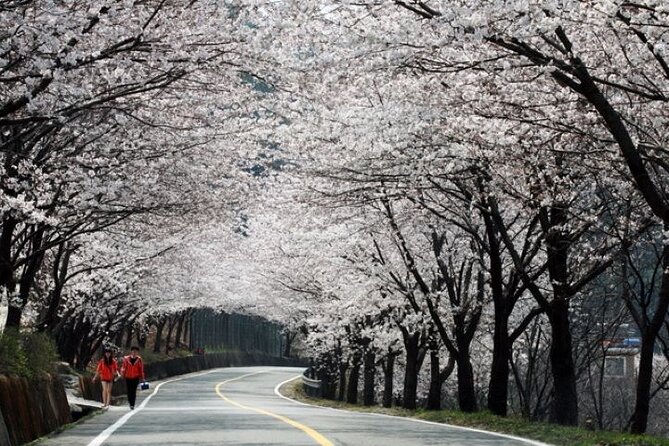
- The 4-kilometer Wedding Road: Hwagae’s cherry-lined road is tied to a local romance legend and is the main spring highlight.
- Private pickup from Busan: Frank Yi or Robin drives and guides your group, with fuel, tolls, parking, and drop-off covered.
- Two different spring seasons: Cherry blossoms usually arrive in April, while the Gwangyang plum festival can occur earlier.
- Tea country beside Jirisan: Dosim Dawon and the Hadong Tea Museum explain why this area is central to Korean tea.
- A full regional meal: Gwangyang bulgogi gives you a chance to try the area’s famous grilled beef rather than eating another quick city meal.
- A genuinely long day: Allow about 9 to 10 hours, including the drive back to Busan.
Why this private Busan day trip works
Hadong and Gwangyang sit well beyond Busan’s main sightseeing zone. Public transport can get you there, but combining the river road, market, temple, tea fields, plum farm, and dinner in one day would be awkward without a car.
This tour solves that problem with pickup at your chosen location around 9:00 a.m. You ride south and west from Busan, with the first major stop at the Seomjin River area around 10:30. At the end of the day, you return to Busan after dinner, with the final drive taking about one hour and 40 minutes.
That private setup matters. You are not waiting for a large group to finish at every stop. One family review described the guide adjusting for two grandmothers, slower walking, and extra toilet breaks. That is exactly where a private tour earns its price.
The guide may be Frank Yi or Robin. Robin is described as arriving on time and speaking very good English, while Frank is identified as the provider and has guided larger family groups with flexible timing. You should still confirm the assigned guide when booking, since both names are connected with the experience.
More Cherry Blossom Tours in South Korea
- Jeju East: Cherry Blossom Early Bird Tour with Hotel Pickup
★ 4.8 · 21 reviews - Jinhae Cherry Blossom Day trip from Busan – A Spring Adventure!
★ 4.5 · 13 reviews - Jinhae Cherry Blossom Festival Gyeonghwa Stn Day Tour from Busan
★ 4.5 · 13 reviews
Seomjin River and the 4-kilometer cherry road
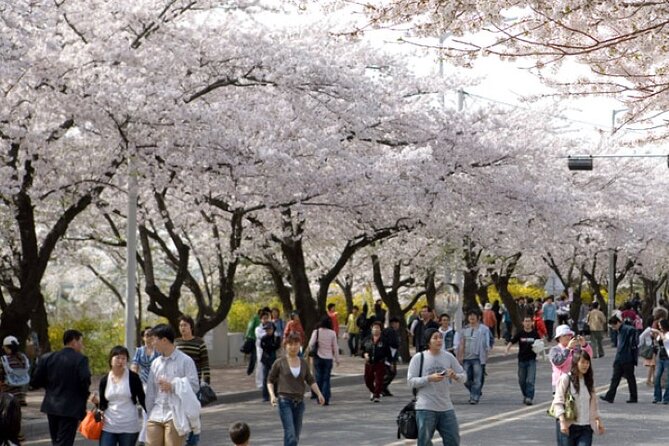
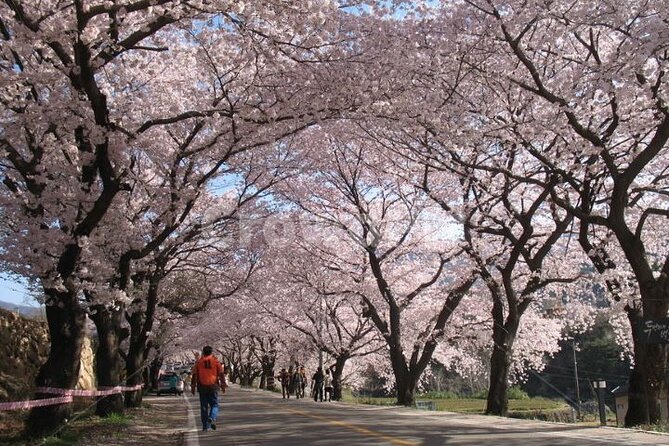
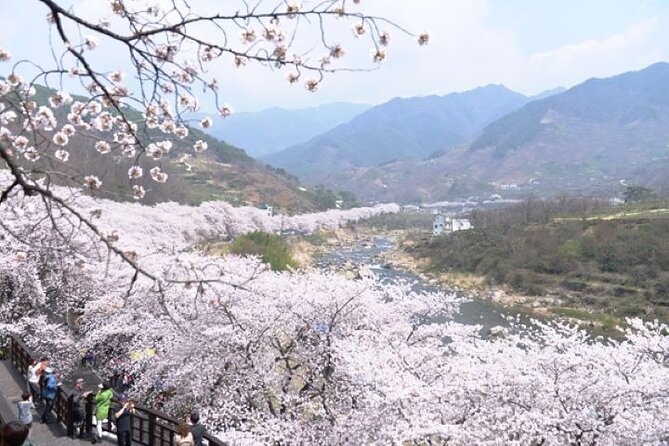
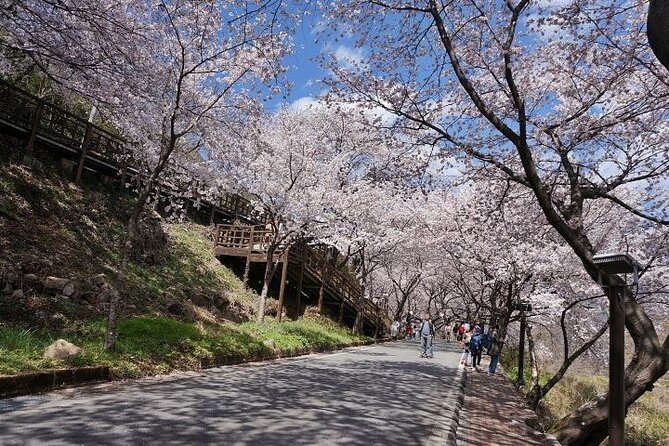
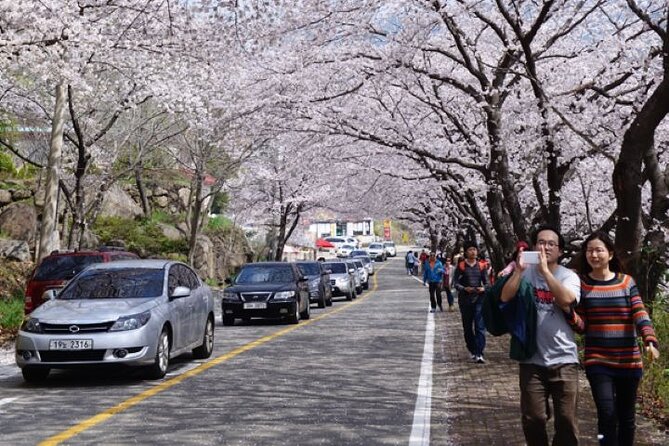
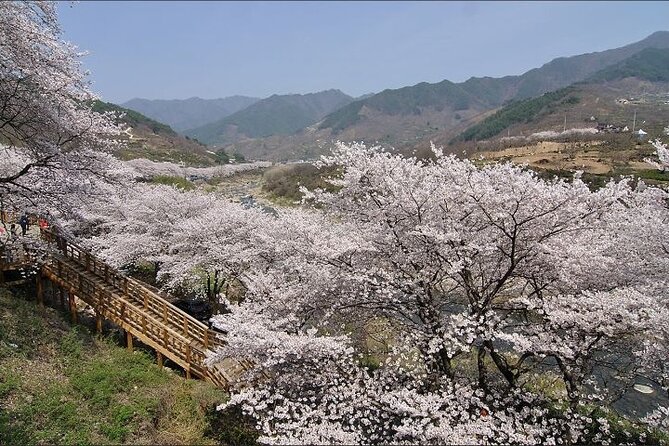
The first stop gives you about two hours around the Seomjin River cherry blossom road. The road through Hwagae is known as Shimni Beotkkot, a name that refers to four kilometers of cherry blossoms.
It is also called the Wedding Road. The old story says that couples who walk along it hand in hand will stay happy together for life. You do not need to be part of a couple to enjoy it, but the romantic nickname helps explain why this road attracts so many people during spring.
The blossoms appear along a wider route called Hwagaedongcheon, which stretches for about 25 kilometers and is associated with local cultural events. In full bloom, the trees are described as looking like white snow falling along the road.
The timing deserves careful attention. The best chance for the cherry blossoms is after the last cold weather has passed and April has arrived. Spring can shift from year to year, so you should ask about the expected bloom period before fixing your date. One family visited about a week too early and saw the early spring season but not the cherry blossoms they had hoped for.
You get two hours here, which is useful during a busy festival period. Still, this is a scenic walking stop, not a long hiking day. Wear shoes that are comfortable on roads and paths, and expect crowds if your date falls near the main bloom.
Hwagae Market for local food and village life
After the river road, you spend about 40 minutes at Hwagaejangteo Market. This is a traditional market with a long connection to the surrounding cherry road, Ssanggyesa Temple, and Jirisan.
The market is known for local produce, regional foods, and small-town shopping. It also appears as a setting in Korean novelist Kim Dong-ri’s work Yeokma, which gives the place a literary connection as well as a practical one.
Forty minutes is enough to walk through the market and pick up a snack, but not enough for a slow meal or extensive shopping. Since food is not included, this can be a good place to buy something small if you want to sample local flavors before dinner.
I would keep your expectations sensible. This is not a polished food hall or a staged cultural show. Its appeal comes from seeing a working traditional market near a major spring attraction. The exact selection will depend on the season and the day you visit.
Ssanggyesa Temple beneath Jirisan
Ssanggyesa Temple receives about one hour of the day. It was founded in 722 on the southern foothills of Jirisan during the reign of Silla King Seongdeok. The temple first carried the name Okcheonsa before taking its current name in 887.
The buildings you see today date from 1632, after the earlier structures were destroyed during the Imjin War. That history gives the stop more weight than a quick photo break. You can look at the temple buildings, mountain setting, and nearby paths while your guide explains the place.
The temple is also associated with a six-kilometer stretch of cherry trees that bloom in spring. The visit therefore adds another blossom area, but it also works outside the exact peak bloom period because the religious site and mountain setting remain the focus.
Nearby attractions include Burilpokpo Falls and a large tea-growing area, though the listed schedule does not give separate time for the waterfall. Do not assume you will be able to add it without changing the day. The route already includes several stops and a long return drive.
Admission is described as free for the scheduled stops, but the tour terms also say meals and admission fees are paid on the spot. I would carry Korean won or a payment method accepted locally and confirm any current charges with the guide.
Same season, a different set of beds:
- Mt. Seorak+Nami Island+Garden of Morning Calm Day Trip from Seoul
★ 5.0 · 959 reviews - Seoul: Nami Island and Garden of Morning Calm opt Railbike
★ 4.6 · 907 reviews - From Seoul: Nami Island, K-drama Garden & Rail Bike Day Tour
★ 4.6 · 724 reviews - Seoul: Mt.Seorak, Nami Island & Korean Garden, No Shopping
★ 4.8 · 614 reviews
Hadong Tea Museum and the story of Korean tea
The Hadong Tea Museum gives you about 40 minutes to learn why this corner of Korea matters to tea production. Hadong is presented as the first tea-producing region in the country, and the museum covers Korean tea culture, its history, and the quality of local green tea.
The museum sits near the tea-growing area and Ssanggyesa Temple at the foot of Jirisan. That location makes sense: you are learning about tea while surrounded by the fields where it is grown.
There is an exhibition hall and a tea-related experience. The short visit will not turn you into a tea expert, but it gives useful context before you see the fields at Dosim Dawon.
This stop is especially useful if you want more than a blossom photograph. You see how food and drink connect to place, climate, farming, and local craft. Hadong tea is made by hand, and the area’s identity is closely tied to its tea plants.
Dosim Dawon and Korea’s old tea trees
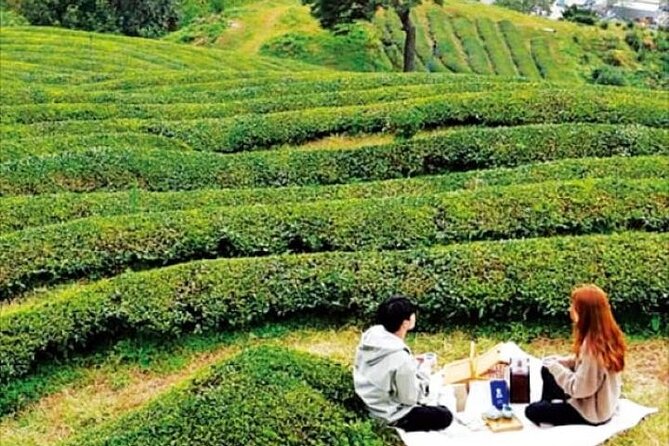
Dosim Dawon is one of the most distinctive stops on the route. You spend about an hour among tea fields in Hwagae-myeon, an area known for early tea cultivation and handmade tea production.
The tea plants grow along the Seomjin River and on the southern slopes of Jirisan. The fields are described as growing among rocks, creating a striking pattern of low tea bushes, stone, river country, and mountain views.
The area also contains a very old tea tree called Korea’s Oldest Tea Tree or the Thousand-Year Tree. The original tea field at Ssanggye Temple is tied to the long history of Korean tea and to a Buddhist temple tradition dating back about 1,000 years.
This is not a large formal garden with every path marked for visitors. It is a working tea-growing area, so the experience depends on the season and exact access conditions. That is part of its appeal. You are seeing the source of the tea rather than only buying a packaged product in a shop.
The tea fields are also a good reason to book a private car. They are outside Busan, and reaching several rural stops in one day by bus would take far more planning and patience.
Gwangyang plum country and the Hong Ssang Ri farm
The itinerary next crosses into Gwangyang for the plum area associated with Hong Ssang Ri. The farm’s story begins in 1965, when Hong Ssang Ri started cultivating 2,000 plum trees.
The Korean plum product you may encounter is maesil-cheong, a sweet and tart plum extract syrup. Fresh Korean plums are covered with oligosaccharide and aged in traditional onggi jars for six months. The result can be used in cooking, mixed into water as iced plum tea, or consumed directly.
Maesil-cheong is also used by home cooks as a sugar substitute in Korean dishes. It adds sweetness and a sour fruit note, while the product is associated with vitamins, antioxidants, and digestion.
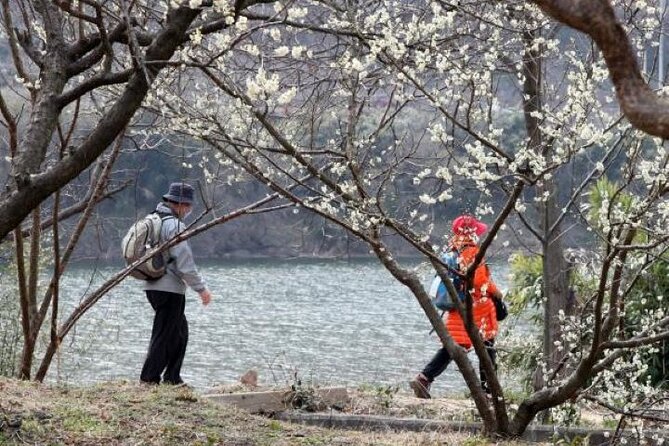
This stop is most rewarding when the plum trees are flowering. That season can come earlier than the Hadong cherry bloom. The schedule therefore combines two spring displays that do not always peak together.
The timing issue is important. A visit during the plum flower festival may be crowded, especially when local people are out enjoying the first signs of spring. One recorded family visit came about a week before the cherry blossoms, so the plum flowers were the main seasonal attraction. That is not a failed trip, but it is a different experience from the classic April cherry road.
Gwangyang bulgogi for the final meal
The day ends at Gwangyang Bulgogi Special District, a restaurant area devoted to the city’s traditional beef barbecue. Bulgogi is thin, tender beef seasoned with a sweet sauce, but Gwangyang’s version has its own traditional seasoning and preparation.
You should expect the meal to include side dishes as well as the beef. Korean barbecue is social food, and this stop gives the day a proper regional finish instead of a rushed convenience-store dinner.
The meal is not included in the $300 price, so plan for an additional cost. The information provided does not give a fixed restaurant or menu price, and the exact bill will depend on what your group orders.
I like this ending because it connects the sightseeing to local food. You have spent the day around farms, tea, markets, and mountain villages, then eat a dish closely tied to Gwangyang. It also gives you a chance to sit down before the drive back to Busan.
What the $300 price really covers
The stated price is $300 per person. That is not a bargain for a simple countryside drive, but it includes the parts that are hardest to arrange independently: private transportation, fuel, tolls, parking, guide and driver service, and pickup and drop-off.
The value improves with a small group. You are paying for a private vehicle and a full day rather than a single admission or short activity. A larger family can also benefit from not having to coordinate several public transport connections.
Meals and admission costs are extra. The scheduled stops are described with free admission, but the terms still tell you to pay admission fees at the site if any apply. You should also budget for market snacks and Gwangyang bulgogi.
The tour is booked far in advance on average, about 193 days. That suggests spring dates can fill early, especially around peak cherry blossom weekends. If your schedule is fixed, reserve early and ask about bloom timing before making nonrefundable plans elsewhere.
Free cancellation is available up to 24 hours before the start time. Changes or cancellations inside that window are not accepted for a refund. The experience also requires at least two people, and if that minimum is not met, you are offered another date or a full refund.
Who should book this day?
I would choose this trip if you want to see rural southern Korea without renting a car. It suits first-time visitors who want cherry blossoms but do not want to work out the route to Hadong themselves.
It is also a strong choice for families. The private format allows slower walking, extra toilet breaks, and schedule changes. That flexibility helped one large family group that included two grandmothers.
You should be comfortable with a long day in the car. The schedule runs about 9 to 10 hours, and the route includes several stops before the return to Busan. If you prefer one major site with plenty of quiet time, this itinerary may feel too packed.
Spring flower hunters should ask one direct question before booking: Which flowers are likely to be in bloom on my date? Cherry blossoms and plum blossoms do not always peak together. Your answer will help you decide if the day is mainly about cherry trees, plum flowers, tea country, or the full mix.
Should you book it?
Book this private tour if you value easy rural access, flexible pacing, and variety more than a low price. It is a useful way to reach Hadong and Gwangyang from Busan, particularly for families, first-time visitors, and anyone who wants an English-speaking guide and driver.
Think twice if you dislike long drives or need guaranteed peak cherry blossoms. The route is far more than a single flower stop, but nature does not follow the calendar. Confirm the likely bloom conditions, bring money for food, and expect a full day that rewards you with temples, tea fields, market life, plum culture, and Gwangyang barbecue.
FAQ
Where does the tour begin?
Pickup is offered from your location in Busan. You are asked to meet the guide on time at the agreed location, where the guide will wait near the exit gate with your name.
How long does the tour last?
The experience lasts approximately 9 to 10 hours. The schedule begins around 9:00 a.m. and includes the drive back to Busan after dinner.
Is transportation private?
Yes. The tour provides private transportation for your group only, along with fuel, tolls, parking fees, and guide or driver service.
Who may guide the tour?
The provider is Frank Yi. The supplied information also identifies Robin as a guide who speaks very good English and handles pickup and guiding duties.
Are meals included?
No. Meals are not included. The itinerary ends with dinner at Gwangyang Bulgogi Special District, and you pay for the meal at the restaurant.
Are admission fees included?
The scheduled stops are described with free admission, but the terms state that admission fees are paid on the spot if applicable. Confirm current charges with the guide.
When do the cherry blossoms usually bloom?
The cherry blossoms are associated with April, after the last cold snap of spring has passed. Exact bloom dates can vary, so you should confirm seasonal conditions before booking.
Can I see plum blossoms and cherry blossoms on the same day?
You can visit both the Gwangyang plum area and the Hadong cherry blossom road, but the flowers may not peak at the same time. An earlier visit may favor plum flowers, while a later April visit may offer a better chance of cherry blossoms.
Is the tour suitable for older people?
Most people can participate, and the private format allows a more flexible pace. A previous family itinerary included two grandmothers, slower walking, and additional toilet breaks.
Can I bring luggage from Busan Gimhae International Airport?
Airport transport from PUS is possible. You should arrange this detail at the time of booking.
What is the cancellation policy?
You can cancel up to 24 hours before the start time for a full refund. Cancellations or changes made less than 24 hours before the start time are not accepted for a refund. The tour may also be canceled if the minimum of two participants is not met, in which case you are offered another option or a full refund.
Full days in the gardens around South Korea
- 2026 JEJU Cherry Blossom West&South Full Day Tour with UNESCO
★ 5.0 · 12 reviews - Full-Day Jinhae Cherry Blossom festival Private tour
★ 5.0 · 3 reviews - Versailles Full Day Bike Tour with Palace, Gardens, & Picnic
★ 5.0 · 2,217 reviews - Giverny Monet’s Garden & Auvers-sur-Oise with Van Gogh House Full Day From Paris
★ 5.0 · 369 reviews
Newly planted garden visits around South Korea
- Small Group Tour East Jeju Cherry Blossom & Woman Diver Show★ 5.0 · 5 reviews
- Small Group West Jeju Cherry Blossom and Strawberry Picking Tour★ 5.0 · 7 reviews
- Jeju BTS & K-drama Fans Small Group Tour incl. Snoopy Garden★ 5.0 · 16 reviews
- 2026 Cherry Blossom East Day Tour in Jeju with UNESCO★ 5.0 · 11 reviews
- 2026 JEJU Cherry Blossom West&South Full Day Tour with UNESCO★ 5.0 · 12 reviews
- Explore Spirited Garden a Cultural Gem in Jeju★ 5.0 · 22 reviews
- [Private Tour] Nami Island+Morning calm Garden+Petite France★ 5.0 · 2 reviews
- Full-Day Jinhae Cherry Blossom festival Private tour★ 5.0 · 3 reviews
Cherry Blossom Tours, bed by bed.
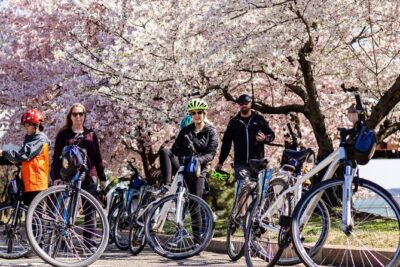
The DC Cherry Blossom Bus Tour with Tidal Basin Guided Walk
Read our review →National Mall & Cherry Blossoms Tour with Optional Museum Tickets
Read our review →
Nagano: 1-Day Snow Monkey & Cherry Blossom Tour in Spring
Read our review →
Nagano Spring: 1-Day Cherry Blossoms & Snow Monkeys Guided Tour
Read our review →Lists this garden visit belongs to