
Review · SPAIN
Alicante: UNESCO Heritage Palm grove + Artistic Garden Tour
Elche’s palm grove is the surprise here: it looks like a natural forest, but it was carefully created by Arab settlers in the tenth century. The old irrigation channels still help water parts of it today. I like the tiny group of four and the BMW transfer, which make this feel more personal than a standard coach outing. I also like the chance to see two very different green spaces in one short trip.
The main catch is that this is not a traditional, fully guided sightseeing tour. The group leader drives you and can accompany you on the walks, but much of the explaining is left to the audio guide or your own phone. If you want detailed answers at every stop, that may feel thin for $75.
Key points to know before booking
- Elche’s palm grove was made by people, not nature: Arab settlers built an irrigation system in the tenth century, creating one of Europe’s largest palm groves.
- You travel by BMW, not bus: The vehicle carries no more than four participants, with pickup and drop-off at selected Alicante locations.
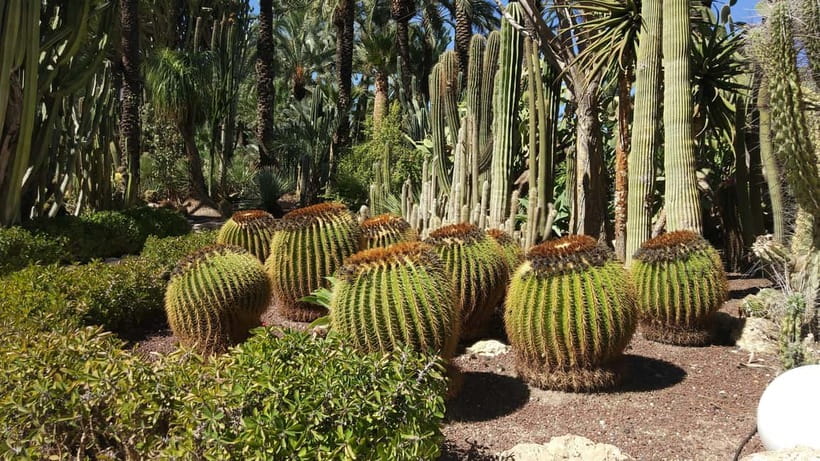
- Huerto del Cura is compact but packed with plant life: Look for palms, cacti, flowers, unusual tree shapes, peacocks, ducks and a pond with colorful fish.
- The Imperial Palm Tree is the garden’s signature sight: Its unusual crown of offshoots rises from the trunk, and a bust recalls Empress Elisabeth of Austria’s 1894 visit.
- Much of the visit is self-guided: You can download a free audio guide in English, Spanish, Catalan, German or French for the artistic garden.
- The tour suits mobile visitors best: Comfortable shoes, internet access and a charged smartphone matter, and the route is not suitable for wheelchair users.
From Alicante to Elche in a four-seat BMW
The trip begins with pickup at one of several Alicante points, including Meliá Alicante, The Outlet Stores Alicante, the Travelodge Alicante Puerto, Aparcamiento LIDL, Hotel Boutique Calas de Alicante, Aparcamiento Supermercado Aldi II and C. Músico Antón Roch, 2A.
The small vehicle is a real part of the experience. With space for no more than four people, you avoid the waiting, crowding and fixed feel of a large bus. You can also ask the group leader questions along the way, though the quality of the spoken information may depend on who is working that day. The listed languages are English, Spanish and Russian.
The ride is best understood as practical transport with some support, not as a moving lecture about Alicante or Elche. That distinction matters. The price covers round-trip car transport, entrance fees and a group leader who also drives, but the walking portions are not presented as a fully narrated private tour.
The total activity is advertised as 150 minutes. The visit to El Palmeral allows about 100 minutes, followed by roughly an hour at the artistic garden. Since those stated blocks add up to more than 150 minutes, exact timing may vary. Ask for the day’s schedule if you have a train, cruise departure or another fixed appointment afterward.
Historic gardens and their stories around Spain:
- Aboriginal Heritage Walk – Royal Botanic Gardens Victoria, Melbourne Gardens
★ 5.0 · 314 reviews - Beijing Historical Tour II including Summer Palace, Lama Temple & Panda Garden
★ 4.0 · 187 reviews - Authentic Amalfi Lemon Tour & Tasting in the Historical Garden
★ 5.0 · 52 reviews
El Palmeral, a working palm oasis in Elche
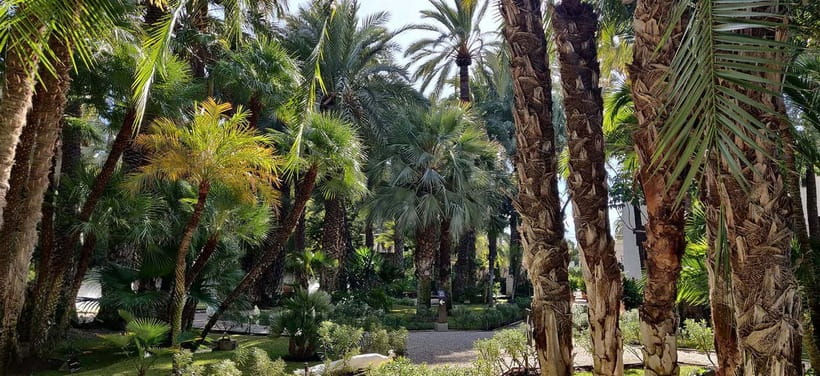
El Palmeral is the larger and more unusual of the two stops. Elche’s palm grove was declared a UNESCO World Heritage Site in 2000, but its importance is not simply the number of palm trees. The grove is an example of people shaping a dry environment with water management, planting and careful maintenance.
The Arabs created the grove in the tenth century. Its irrigation system divided water through channels so the palms could grow in an otherwise demanding climate. Some of that system is still in use, which gives the visit a useful bit of context: you are not just walking among palms, you are seeing an old agricultural system that remains part of the site’s identity.
You get free time here for an independent walk lasting about 100 minutes. The freedom is welcome because the grove is best taken at an unhurried pace. You can watch for different forms of palms, study the way the paths pass through the planting, and pause for photographs without being hurried from one explanation to the next.
Still, set your expectations correctly. El Palmeral is also a public park, not a preserved archaeological building with exhibits at every turn. Its appeal comes from the overall setting, the scale of the planting and the story of water and cultivation. If you expect a long list of dramatic monuments, it may feel quiet or under-explained.
The season can affect the impression. One booking account found the grove less impressive than expected in November, while the artistic garden received a warmer response. That does not make the palm grove a poor stop, but it suggests that your enjoyment will depend on what you want from it. This is a place for shade, plants and local agricultural history, not a spectacle at every step.
The group leader can accompany you during the walk if you wish. The supplied information does not promise a detailed guided talk, so download any available material beforehand and keep your phone charged. Internet access is specifically recommended, and it is worth checking that your audio files or app work before leaving Alicante.
Huerto del Cura and the Imperial Palm Tree
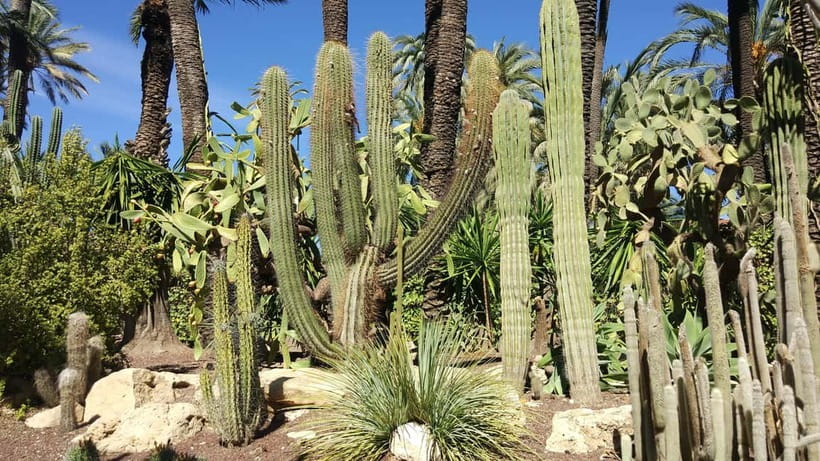
The second stop is Huerto del Cura, a private historic garden recognized as a National Artistic Garden in 1943 and listed as part of the Cultural Heritage of the Valencian Community.
It is much more compact than El Palmeral, but it makes a strong contrast. Instead of a broad palm-growing area, you find a designed garden with palms, cacti, flowers and many types of trees arranged for close viewing. This is the place where you can spend time noticing shapes, textures and odd plant forms rather than simply walking through a large grove.
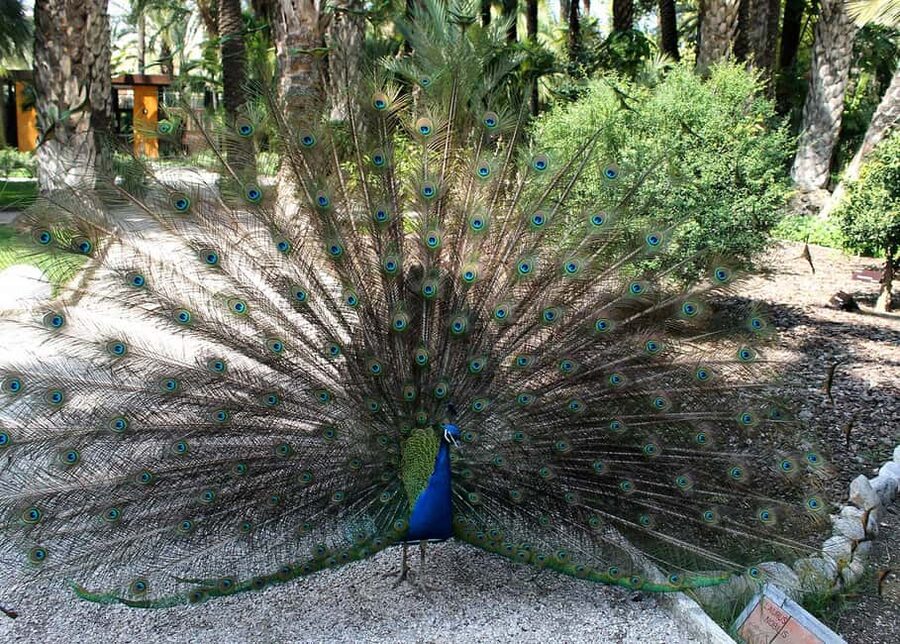
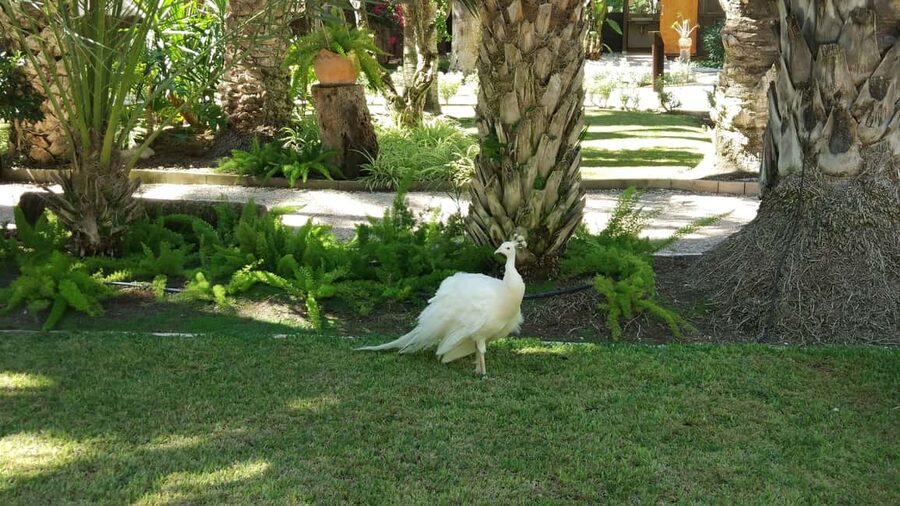
A pond contains colorful fish, and peacocks and ducks live in the garden. Food for the animals is sold at the on-site store. If you want to feed them, buy the approved food there rather than bringing your own. Animal feeding can be a pleasant extra, but it is not included in the tour price.
The garden’s main attraction is the Imperial Palm Tree. Its name refers to Empress Elisabeth of Austria, often called Sissi, who visited the orchard in 1894. Chaplain Castaño dedicated the palm to her, and a bust of the empress sits near the north side of the tree.
What makes this palm unusual is its growth pattern. New shoots normally form low on the trunk, often when the parent palm is 10 to 15 years old. In this case, the shoots developed when the main palm was more than 30 years old and appeared about two meters above the ground, far from the roots. That odd structure is the reason the tree deserves a close look rather than a quick photograph from the path.
The garden includes a free audio guide that you can download at the entrance. It is available in English, Spanish, Catalan, German and French. This helps fill the gap left by the absence of a dedicated walking guide, but it also means you need to manage your own phone, connection and listening pace.
The audio guide is most useful for people who enjoy stopping at their own speed. It is less satisfying if you prefer to ask questions as you go. A group leader may accompany you, but the experience remains largely independent. I would treat the audio guide as the main source of interpretation and the group leader as your transport contact and general host.
What the guide service really provides
The experience lists a host or greeter in English, Spanish or Russian, along with a group leader and driver. That is not the same thing as a botanical expert or licensed cultural guide leading both sites.
This distinction is important because the reviews give mixed signals about the spoken commentary. One French-speaking booking party specifically wished for a French-speaking person. Another praised the guide’s kindness and strong knowledge of the sites. Other accounts found the guide’s English limited and felt the outing worked mainly as a taxi service between the gardens.
You should therefore book this for the transport and access first, and for interpretation second. If your driver happens to be an excellent source of local information, that is a bonus. If not, you still have the two admissions, a small vehicle and a simple way to reach Elche from Alicante.
The audio guide reduces the risk of getting no context at all, but it does not replace a live guide for every type of visitor. Bring questions, yet be prepared to find some answers through the app rather than from the person accompanying you.
More gardens worth a morning in Spain:
- Granada: Alhambra & Gardens Tour w/Nasrid Palaces Option
★ 4.2 · 7,022 reviews - Granada: Alhambra Gardens and Generalife Ticket
★ 4.4 · 2,195 reviews - Granada: Alhambra Guided Tour with Nasrid Palaces & Gardens
★ 4.7 · 2,190 reviews - Alhambra &Charles Palace Guided Tour with Optional Nasrid Palaces
★ 4.5 · 2,149 reviews
Is $75 a fair price?
At $75 per person, this is not the cheapest way to see two gardens. The value depends on how much you place on small-group transport and convenience.
For a group of four, the BMW transfer is far more intimate than a bus. You get pickup and drop-off at listed Alicante points, entrance fees and a relatively short 150-minute outing. If you want a simple half-day trip without arranging your own transport to Elche, those details may justify the cost.
The price is harder to defend if you mainly want a guided cultural tour. The visits are independent, and the tour does not promise a specialist who explains every plant, irrigation channel or historical detail. You are paying for door-to-door organization, the small vehicle and the chance to combine the sites efficiently.
I would compare the price with your own priorities. Solo visitors and couples may find the convenience useful, especially if they do not want to plan local transport. A group of four can also enjoy the private feel without hiring a fully private car. Independent visitors who already have transport and enjoy researching gardens may find the package less attractive.
Practical details that affect your visit

Wear comfortable shoes. Both stops involve walking, and neither is designed as a sit-down sightseeing experience. Bring a camera, a charged smartphone and internet access. Your phone matters because the artistic garden’s audio guide is downloaded at the entrance.
Smoking, alcohol and drugs are not allowed. Pet food is not included, so budget separately if you want to feed the ducks or peacocks. The tour is not suitable for wheelchair users.
Cancellation is flexible up to 24 hours before departure for a full refund, and you can reserve now and pay later. The pickup and return points are the same group of Alicante locations, so check the exact meeting point carefully. Contact the provider if you need another pickup point or if your preferred date does not appear available.
The tour is not built around food, shopping or a long stop in Elche. Its focus is the two gardens. Keep that in mind when planning the rest of your day.
Who will enjoy this garden outing most?
I would recommend it to plant lovers, photographers and anyone who wants a quiet break from Alicante’s city streets. The two sites work well together because El Palmeral shows a broad, historic palm-growing system, while Huerto del Cura gives you a closer look at designed planting and unusual specimens.
It also suits visitors who value small groups. A maximum of four people is a major advantage over standard coach tours, especially when you want a calmer ride and a little flexibility during the walks.
Families may enjoy the fish, ducks and peacocks, though adults should buy the correct food at the garden store. The outing can also suit solo visitors who would rather not arrange transport alone.
I would be cautious if you need a polished, expert-led tour in a particular language. French is available for the audio guide, but the listed live host languages are English, Spanish and Russian. If detailed botanical or historical explanations are central to your day, confirm the language and guiding arrangements before booking.
Should you book this Alicante garden tour?

Book it if you want easy transport from Alicante, a four-person group and two distinct garden visits without spending a full day away. The UNESCO palm grove is worth seeing for its Arab irrigation system and unusual cultivated setting, while Huerto del Cura offers more concentrated visual interest, especially around the Imperial Palm Tree.
Skip it if you expect a traditional guided tour with a specialist answering questions at every stop. You will do much of the exploring yourself, and the audio guide is an important part of the experience. For the right visitor, $75 buys comfort, access and efficient transport. For someone seeking expert commentary, it may feel more like a pleasant private transfer with garden admissions attached.
FAQ
How long does the experience last?
The advertised duration is 150 minutes. The planned schedule includes about 100 minutes at El Palmeral and around one hour at the artistic garden, so the exact timing may vary.
How many people can join the group?
The group is limited to four participants. Transport is provided by BMW car rather than by bus.
Where can I be picked up in Alicante?
Pickup points include The Outlet Stores Alicante, Meliá Alicante, Aparcamiento LIDL, Hotel Boutique Calas de Alicante, Aparcamiento Supermercado Aldi II, Hotel Travelodge Alicante Puerto and C. Músico Antón Roch, 2A.
What are the two places visited?
The tour visits El Palmeral, Europe’s largest palm grove and a UNESCO World Heritage Site, followed by Huerto del Cura, a historic garden recognized as a National Artistic Garden.
Is a guide included?
A group leader and driver are included, with service listed in English, Spanish and Russian. The walking visits are mainly independent, and the Huerto del Cura Garden provides a free audio guide.
Which languages are available for the audio guide?
The audio guide is available in English, Spanish, Catalan, German and French.
Can I feed the animals at Huerto del Cura?
Yes. The garden has peacocks, ducks and fish, and food can be bought at the store on the garden grounds. Pet food is not included in the tour price.
Is the tour suitable for wheelchair users?
No. The experience is listed as not suitable for wheelchair users.
Newly planted garden visits around Spain
- Lanzarote Tour: Lagomar Museum, Cactus Garden & La Graciosa★ 4.5 · 18 reviews
- Tour to César Manrique Foundation, Cactus Garden and Teguise for cruise passengers★ 4.5 · 8 reviews
- Aromatic Experience in the Medicinal Garden in Ibiza★ 5.0 · 7 reviews
- Tickets included: Alhambra Tour (Gardens, Alcazaba, Generalife)★ 4.5 · 101 reviews
- Alhambra Gardens, Generalife and Alcazaba Tickets & Local Guide★ 3.5 · 5 reviews
- Tickets included: Alhambra (Gardens)★ 4.5 · 8 reviews
- Guided tour of the Alhambra: Generalife and its gardens★ 4.0 · 9 reviews
- Generalife, Gardens and Alcazaba guided tour (without Nasrid Palaces)★ 3.5 · 3 reviews
Spain Garden Tours, bed by bed.

Granada: Alhambra & Gardens Tour w/Nasrid Palaces Option
Read our review →
Granada: Alhambra Gardens and Generalife Ticket
Read our review →
Alhambra &Charles Palace Guided Tour with Optional Nasrid Palaces
Read our review →
Granada: Alhambra and Generalife Garden Ticket & Guided Tour
Read our review →
Granada: 3-Hour Alhambra and Generalife Gardens Guided Tour
Read our review →Blanes: Marimurtra Botanical Garden Entry Ticket
Read our review →
Córdoba: Viana Palace Gardens and Patios Entry Ticket
Read our review →
Icod de los Vinos: Dragon Tree & Botanical Garden Ticket
Read our review →Lists this garden visit belongs to